
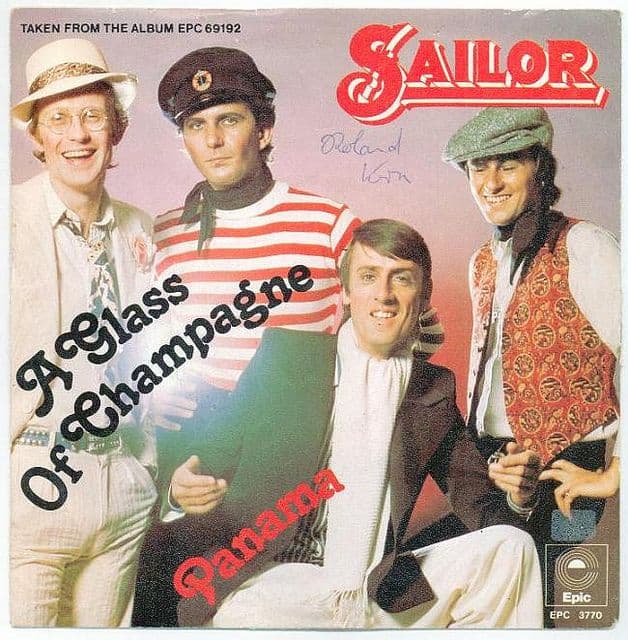
A playful toast to fleeting joy, nostalgia, and the fragile sparkle of happiness in a restless world
When “A Glass of Champagne” by Sailor first appeared in late 1975, it felt like an unexpected wink from popular music—light on its feet, oddly theatrical, and yet strangely poignant beneath its frothy surface. Released as a single from the band’s debut album Trouble (1975), the song went on to reach No. 1 on the UK Singles Chart in January 1976, holding the top position for several weeks. It also topped charts in multiple European countries, including the Netherlands, Belgium, and parts of Scandinavia, becoming one of the most distinctive pop hits of the mid-1970s. These chart facts matter, because they remind us that what initially sounded like a novelty record was, in fact, embraced by a very wide audience at a very particular cultural moment.
Sailor were not a typical pop group. Formed in the early 1970s, they were known for blending pop-rock with vaudeville, cabaret, and music-hall traditions. Their visual style—pinstripe suits, bowler hats, and an air of old-world showmanship—set them apart immediately. At the center of their sound was frontman Georg Kajanus, whose songwriting leaned toward irony, satire, and character-driven storytelling rather than straightforward pop confession. “A Glass of Champagne” is perhaps the purest distillation of that approach.
On the surface, the song feels effervescent and almost silly: a bouncing piano line, singalong chorus, and a melody that seems to smile as it moves. But listen more closely, and a different emotional register begins to emerge. The lyrics tell a story of brief encounters, superficial glamour, and the hollow rituals of celebration. A glass of champagne, after all, is not a deep drink—it sparkles, it fizzes, and it disappears quickly. In that sense, the song uses champagne as a metaphor for fleeting pleasure, social performance, and the illusion of happiness. What we raise our glasses to is often gone by the time the bubbles fade.
The timing of the song’s success is crucial to understanding its deeper resonance. By the mid-1970s, much of the Western world was emerging from the optimism of the 1960s into a period marked by economic uncertainty, political disillusionment, and cultural fatigue. Against that backdrop, “A Glass of Champagne” offered escapism—but not without self-awareness. It dances, but it also knows it is dancing. The cheerfulness is tinged with irony, and the humor carries a subtle sadness, as if the band is gently reminding us that the party cannot last forever.
Musically, the track stands out for its deliberate throwback style. The honky-tonk piano, upright bass feel, and almost theatrical vocal delivery recall pre-rock entertainment traditions. This was not accidental. Sailor were consciously reaching backward, using older musical forms to comment on modern life. In doing so, they created a song that felt both familiar and strangely out of time—one reason it has aged better than many hits of its era.
The success of “A Glass of Champagne” also defined Sailor in the public imagination, sometimes to their detriment. While the band released other thoughtful and well-crafted songs, this track became their signature, often labeled a “novelty hit.” Yet that label overlooks its craftsmanship and emotional intelligence. Beneath the jaunty exterior lies a song that understands human behavior with quiet clarity: our love of ritual, our attraction to sparkle, and our tendency to confuse celebration with fulfillment.
Today, listening to “A Glass of Champagne” can feel like opening an old photograph album. The sound instantly evokes a specific era, but the emotions it touches are timeless. It reminds us of parties long ended, conversations half-remembered, and moments that once felt important simply because they were shared. The song does not judge these moments—it simply observes them, raises a glass, and moves on.
In that way, “A Glass of Champagne” remains more than a catchy tune from the past. It is a small, elegant reflection on impermanence, wrapped in melody and humor. And perhaps that is why, decades later, its sparkle has not entirely faded.