
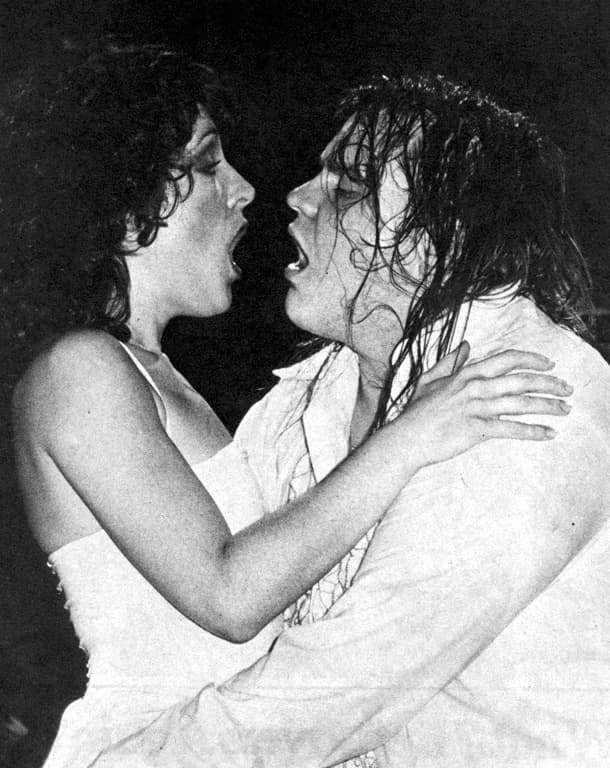
A song that turns youthful desire into thunder, speed, and one last, reckless promise of freedom
When “Bat Out of Hell” first roared into the world, it did not arrive as a polite hit single neatly packaged for radio. It arrived like a runaway motorcycle at midnight—loud, overlong, excessive, and impossible to ignore. Performed by Meat Loaf and written by Jim Steinman, the song opened the album Bat Out of Hell (released in October 1977), an album that would go on to become one of the best-selling records in popular music history. Though its rise was slow and, at first, uncertain, time proved far kinder than the charts ever could in those early days.
Upon its eventual single release, “Bat Out of Hell” reached No. 15 on the UK Singles Chart in 1979 and No. 16 on the Billboard Hot 100 in the United States, impressive positions for a song nearly ten minutes long—an outright rebellion against radio conventions. The album itself told a deeper story: initially modest in the U.S., it climbed steadily to No. 14 on the Billboard 200, while in the UK it became a cultural phenomenon, ultimately reaching No. 1 and staying on the charts for years. These numbers matter, but they only hint at the deeper impact of the work.
At its heart, “Bat Out of Hell” is a song about youth standing at the edge of adulthood, trembling between desire and consequence. Steinman’s lyrics borrow the language of teenage rebellion, classic rock bravado, and almost operatic romanticism. The narrator is not simply racing through the night; he is racing against time itself. Lines about promises made “before the morning comes” and vows sworn “like a bat out of hell” are less about speed than about urgency—the awareness that innocence, once lost, never returns.
Musically, the song is a bold fusion of rock, Wagnerian drama, and Phil Spector–style grandeur. Todd Rundgren’s production layers pounding pianos, surging guitars, and dramatic shifts in tempo that feel closer to musical theater than traditional rock. Meat Loaf’s voice—huge, theatrical, and emotionally naked—turns the song into a confession shouted at full volume. He does not sing to the listener so much as at the moment itself, as if trying to hold it still by sheer force.
The backstory behind the album only deepens its legend. Before becoming a global success, Bat Out of Hell was rejected by numerous record labels, deemed too strange, too long, too theatrical. Steinman and Meat Loaf were told it had no place in the late-1970s music market. Yet it was precisely this refusal to compromise that gave the song its enduring power. It did not chase trends; it built its own world and invited listeners to live inside it.
For many, “Bat Out of Hell” became inseparable from memories of late-night drives, first loves, and moments when the future still felt dangerously open. Its drama mirrors the intensity with which youth experiences everything for the first time—love, fear, rebellion, and loss. Even decades later, the song retains that emotional voltage. It may sound grand, even exaggerated, but so do memories when viewed from the distance of time.
In the end, Meat Loaf did not simply record a rock song; he embodied a feeling. “Bat Out of Hell” remains a reminder of when music dared to be excessive, when songs were allowed to run long because emotions did too. It stands today not merely as a classic, but as a monument to the moment when rock music believed, without irony, that everything mattered—and mattered right now.