
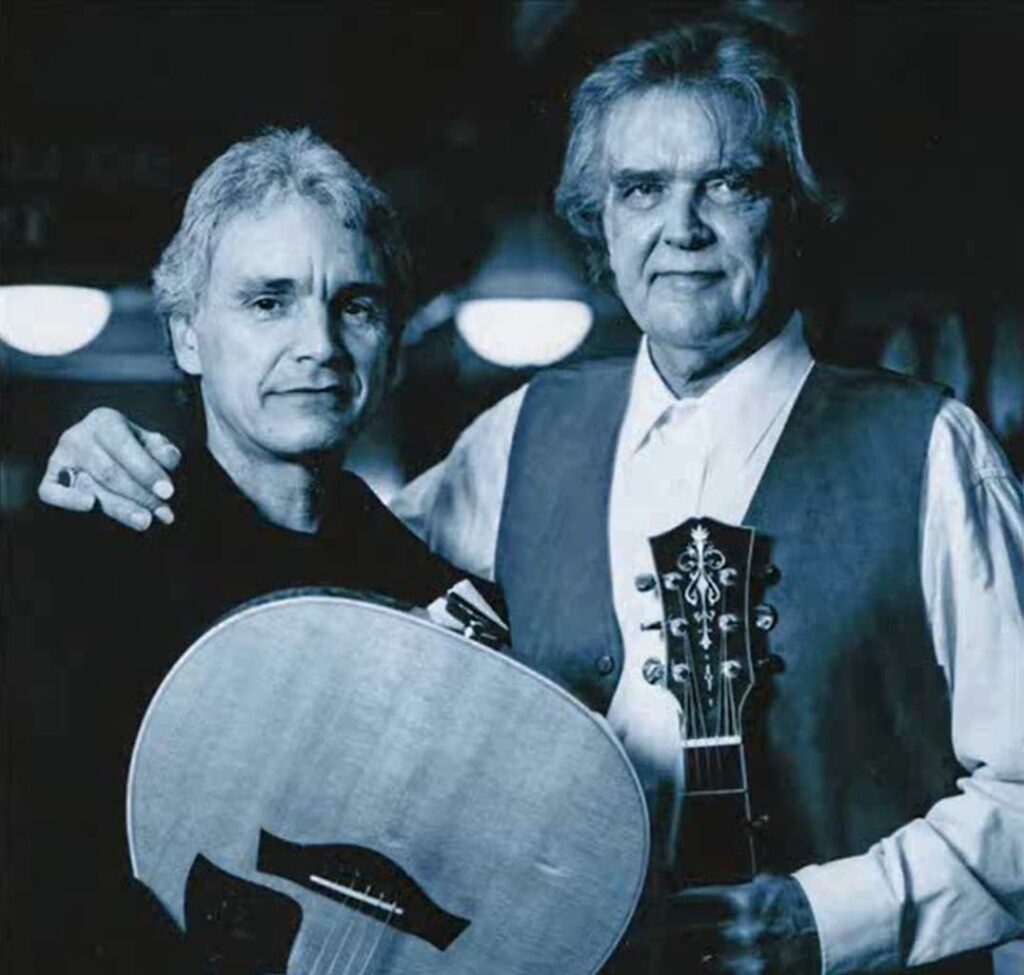
The deep, mystical bond between a musician and his instrument, embodied in “The Guitar.”
When we speak of Verlon Thompson and “The Guitar,” we are really touching on a song deeply associated with his longtime partner, Guy Clark, who co‑wrote it with him. Released on Clark’s Somedays the Song Writes You album in 2009, the track never climbed mainstream charts, but its resonance has grown steadily in the hearts of folk and Americana lovers — a quiet classic beloved for its poetic simplicity and emotional weight.
Listening to “The Guitar” is like stepping into a campfire story told under a wide, star-filled sky. The song begins with a narrator walking into a dusty pawn shop, drawn to a “beat-up old guitar hanging on the wall.” There’s an air of magic in the exchange: the shopkeeper challenges him, “play it and see what haunts it.” As the narrator’s fingers touch the strings, something extraordinary happens — his fingers “turned to lightnin’,” and he plays as though the guitar is channeling some ancient energy.
In many ways, the guitar in the song is not just an instrument — it becomes a living vessel of memory, of stories, of souls. The old man, moved by what he hears, gifts the guitar: the instrument seems to have been waiting all its life, not just for anyone, but for him. That moment — haunting, almost ethereal — captures something very tender: the idea that art, and especially music, is not merely made, but discovered; revealed.
The Story Behind the Song
The story of “The Guitar” is almost as poetic as the song itself. According to Thompson, he and Guy Clark wrote it during a songwriting workshop at Jorma Kaukonen’s Fur Peace Ranch in Ohio. It started as a class project attended by several students. Someone in the class simply suggested: “let’s write a song about a guitar,” because they all had their guitars on their laps. By the end of that day, Clark and Thompson had sketched out the lyrics. But the song went into a drawer and was largely forgotten — until a couple of years later, when one of the students called Thompson asking if there was sheet music. Thompson retrieved the lyrics, started speaking them over a chord progression, and felt chills. He called Clark, they recorded it two days later.
Thompson also shared a deeply personal anecdote: the guitar he plays in connection with this song is a Bourgeois Country Boy. He had long sought that model, and to his surprise, Clark told him he had one “under his bed” — tucked away, unused. Clark gave it to him, saying: “I want you to have it … It’ll always be my guitar, but you can take care of it.” That kind of trust, generosity, and shared musical devotion is woven into every note of the song.
Meaning and Significance
At its heart, “The Guitar” is both nostalgic and mystical. It’s not just about finding a musical instrument: it’s about the search for connection — between past and present, between human and music, between maker and muse. The pawnshop becomes a metaphor for forgotten stories, lost souls — things that have been worn by time, but not emptied of meaning.
The moment when the narrator’s fingers “turned to lightning” suggests that sometimes technique alone is not enough; what matters is a gesture, a calling from something larger, something timeless. The old man recognizing that spark, and giving the guitar freely, is both a transfer of trust and a passing of legacy.
For older listeners especially, the song may evoke memories of their own first instruments, or the quiet yearning to preserve something delicate and meaningful. It’s a testament to how a simple piece of wood, strings, and calluses can hold lifetimes’ worth of stories. The guitar becomes a confidant, a friend, and a witness — as sacred as any diary or photograph.
Verlon Thompson’s Role and Legacy
While Guy Clark often performs “The Guitar”, Verlon Thompson’s presence is deeply embedded in its DNA. Thompson is a masterful folk and Americana songwriter, guitarist, and troubadour from Binger, Oklahoma, active since the early 1980s. Over decades, he has collaborated closely with Clark — writing, producing, touring — and his guitar playing and narrative sensibility shine throughout Clark’s work.
On Clark’s Somedays the Song Writes You (released on September 22, 2009), Thompson contributed not just as co-writer, but also as musician and producer. That album, warm and unadorned in production, feels like home — and “The Guitar” stands out as a delicate crown jewel of that collection.
Although “The Guitar” did not chart on mainstream pop or country charts, its importance is not measured in chart positions. Rather, its legacy grows in quieter spaces — in living rooms, at jam circles, around campfires, and in the hearts of those who understand its gentle magic. Fans often speak of getting “chills” when listening, calling it a “guitar fantasy” or even an anthem for anyone who has ever felt a deep, soulful bond with their instrument.