
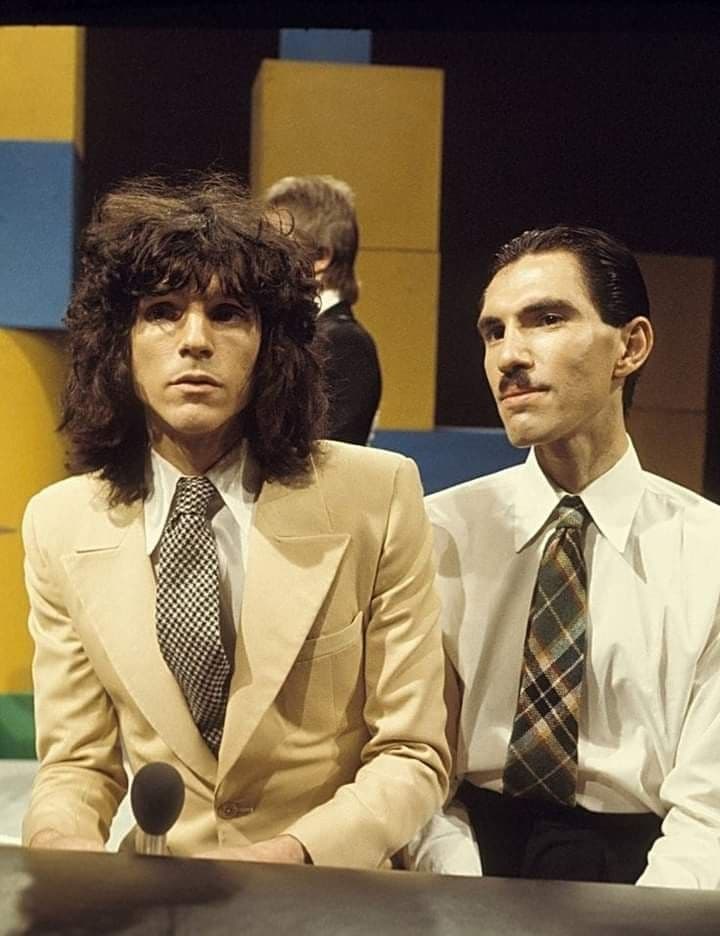
This Town Ain’t Big Enough for Both of Us — a theatrical explosion where ambition, obsession, and irony collide
When “This Town Ain’t Big Enough for Both of Us” burst onto the airwaves in 1974, it didn’t simply announce a new song — it announced a worldview. Performed by Sparks, the idiosyncratic duo of brothers Ron Mael and Russell Mael, the track arrived like a cinematic gunshot, dramatic, witty, and gloriously over the top. Upon its release, the song climbed to No. 2 on the UK Singles Chart, becoming the band’s breakthrough hit and one of the most distinctive records of the decade. It came from the album Kimono My House, released in 1974, a record that would cement Sparks as outsiders who somehow stepped straight into the center of British pop culture.
From the very first pounding piano chord, there is no easing in. Ron Mael’s relentless, almost operatic keyboard figure drives the song with a sense of urgency, while Russell Mael’s extraordinary falsetto slices through the mix like a declaration of intent. This was not rock as rebellion in the traditional sense; this was rock as theater, irony, and controlled chaos.
The story behind the song is as unconventional as the sound itself. At the time, Sparks were an American band who found their greatest success not at home, but in the United Kingdom. British audiences, perhaps more attuned to eccentricity and wit, immediately embraced their odd elegance and unapologetic intelligence. “This Town Ain’t Big Enough for Both of Us” became the perfect calling card: bold, absurd, dramatic, and strangely relatable.
Lyrically, the song plays like a series of vignettes — fragments of obsession, jealousy, competition, and paranoia. Lines about encounters in the desert, threats whispered through clenched teeth, and lovers framed as adversaries blur together into a surreal narrative. The title itself feels like something pulled from a classic Western, yet Sparks transform it into a metaphor for emotional claustrophobia. Love, ambition, ego — all fighting for space in a world that suddenly feels too small.
What makes the song so enduring is not just its cleverness, but its emotional undercurrent. Beneath the theatrical bravado lies a very real fear: the fear of being replaced, overshadowed, or erased. In that sense, the song speaks to anyone who has ever felt that the room wasn’t big enough for two dreams, two egos, or two competing desires. The exaggeration only sharpens the truth.
Kimono My House as an album marked a turning point for Sparks. It introduced a refined blend of glam rock, art pop, and intellectual satire, wrapped in a sound that was both aggressive and elegant. While glam rock at the time often celebrated excess and sexuality, Sparks offered something different — tension, irony, and emotional distance, delivered with impeccable precision. “This Town Ain’t Big Enough for Both of Us” stood at the center of that vision, fearless in its refusal to sound like anything else on the radio.
For listeners encountering the song then — or rediscovering it years later — the experience is unforgettable. It doesn’t comfort; it confronts. It doesn’t explain; it declares. Yet there is something deeply nostalgic about it now. Not because it feels dated, but because it represents a moment when pop music allowed itself to be strange, intelligent, and uncompromising — when a song could succeed without softening its edges.
Today, the track stands as one of the great statements of 1970s pop artistry. It reminds us that music can be dramatic without being hollow, clever without being cold, and bold without losing emotional weight. Sparks never asked for permission, and “This Town Ain’t Big Enough for Both of Us” remains proof that sometimes, the most lasting songs are the ones that dare to take up all the space in the room — and refuse to share it.