
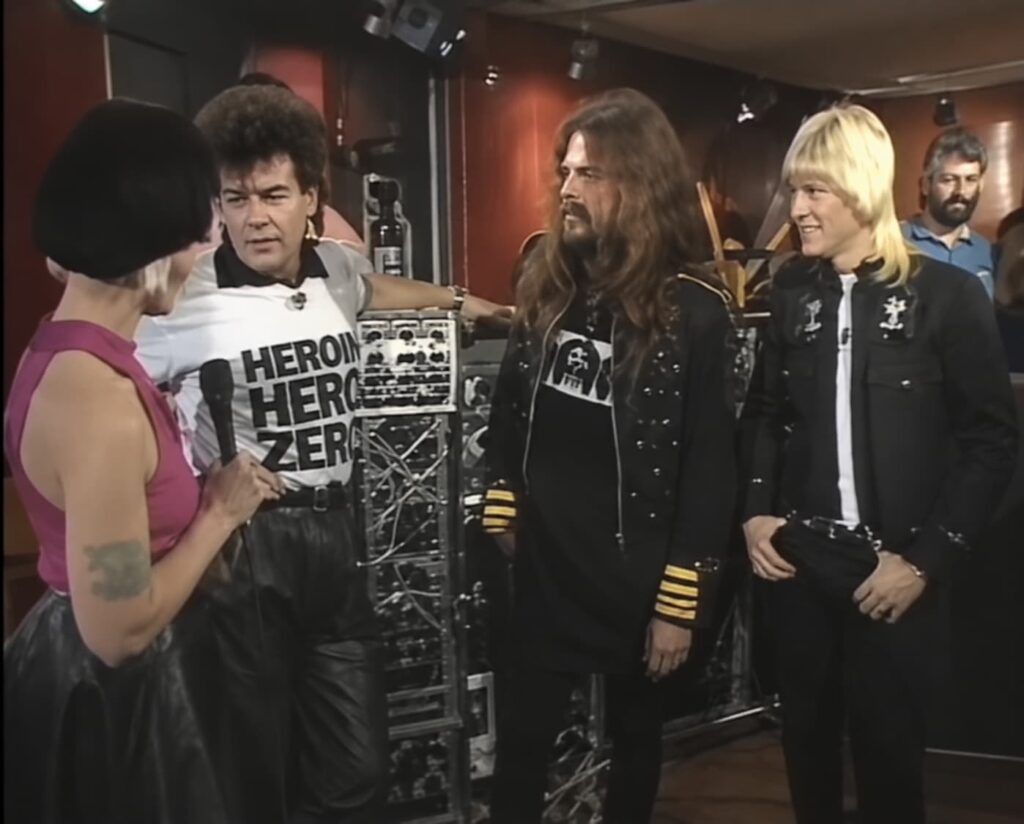
When Glam Rock Looked Back: Roy Wood, Gary Glitter and Brian Connolly Revisit a Defining Era in 1982
In a lighthearted television interview broadcast in 1982, Roy Wood, Gary Glitter and Brian Connolly gathered to reflect on the flamboyant world of Glam Rock, offering a rare glimpse into a musical movement that had transformed British popular culture less than a decade earlier.
The conversation centered on one of the most recognizable symbols of the Glam Rock era: the extravagant costumes that helped define the genre during its peak in the early 1970s. Surrounded by examples of their stage clothing, the three performers looked back with humor and affection on a period when bold fashion choices were as important to the spectacle as the music itself.
Roy Wood proudly displayed one of his famous stage outfits, complete with mirrors incorporated into the design. Joking that they allowed him to check his makeup while performing, he highlighted the playful creativity that became a hallmark of Glam Rock. The discussion frequently drifted into laughter as the artists exchanged stories about their clothing and stage appearances.
Several garments shown during the interview dated back to 1973 and 1974. Rather than discarding them, the musicians had kept many of these costumes tucked away for years. Their decision proved meaningful as fashion trends began to revisit elements of Glam Rock in the early 1980s. One participant remarked that he had always believed the style would eventually return.
The interview also explored the contrast between stage life and everyday life. While the elaborate outfits were designed for performance, the artists admitted that wearing such clothing in ordinary settings was often less practical. Their comments illustrated how Glam Rock blurred the boundaries between theatrical performance and personal identity while remaining firmly rooted in entertainment.
Footwear, tailoring and costume construction became additional topics of discussion. The performers spoke openly about custom made clothing and the exaggerated silhouettes that helped create their larger than life stage personas. Their remarks revealed the amount of craftsmanship involved in building the visual image associated with Glam Rock.
Beyond the humor, the interview served as a reminder of the cultural impact of a movement that encouraged individuality, fantasy and self expression. The colorful costumes displayed during the program were more than relics from another decade. They represented a period when popular music embraced spectacle without apology and when artists challenged conventional expectations through both sound and appearance.
Viewed today, the 1982 conversation captures a unique moment in music history. It documents leading figures of Glam Rock looking back on their own legacy with warmth, pride and a sense of amusement, preserving memories of an era whose influence continues to echo through popular culture decades later.