
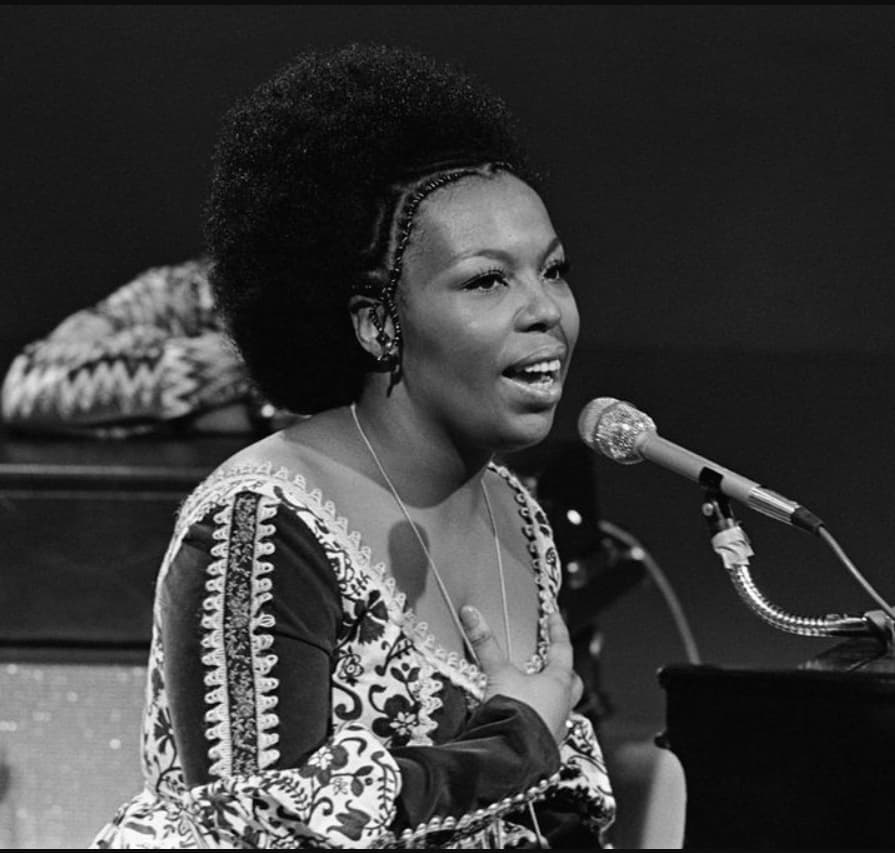
A Song That Whispered Its Way Into Our Hearts and Never Truly Left
When “Killing Me Softly with His Song” was released in January 1973, it did not simply climb the charts — it seemed to float there, sustained by something far more enduring than commercial momentum. Performed with exquisite restraint by Roberta Flack, the song reached No. 1 on the Billboard Hot 100 in the United States in February 1973 and remained there for five consecutive weeks. It also topped the Billboard Easy Listening chart, and went on to win the Grammy Award for Record of the Year and Best Female Pop Vocal Performance in 1974. It became, quite simply, one of the defining ballads of its era.
But numbers and trophies only tell part of the story.
The origins of the song are as delicate as its melody. The lyrics were inspired by singer-songwriter Lori Lieberman, who, in 1971, attended a performance by Don McLean at the Troubadour in Los Angeles. Deeply moved by McLean’s haunting performance of “Empty Chairs,” Lieberman described the experience to songwriters Charles Fox and Norman Gimbel, who then shaped her emotional response into the lyrics of “Killing Me Softly with His Song.” Lieberman recorded the song first in 1972, but it was Roberta Flack’s interpretation that transformed it into something timeless.
Flack herself discovered the song while on a plane, listening to Lieberman’s version during a flight. She later recalled being so captivated that she immediately began reworking it, slowing the tempo and reshaping its phrasing. What emerged was not merely a cover — it was a reinvention. Where Lieberman’s recording had a folk sensibility, Flack’s version unfolded like a confession whispered across a candlelit room. The arrangement, featured on her album Killing Me Softly (1973), is sparse yet lush: gentle strings, understated piano, and that voice — warm, controlled, almost conversational — delivering lines that feel intensely personal.
There is something profoundly intimate in the way Roberta Flack sings this song. She does not overpower it. She inhabits it. Each pause feels intentional; each breath seems to carry the weight of unspoken memory. In an era when vocal showmanship was often about projection and volume, Flack’s restraint was radical. She trusted silence as much as sound. And in doing so, she allowed listeners to step inside the story.
The song’s meaning remains universal: the experience of hearing a performer articulate emotions so precisely that it feels like one’s own life is being sung back. “Strumming my pain with his fingers… telling my whole life with his words…” — these lines capture that uncanny moment when art mirrors experience so accurately that it startles. The title phrase itself, paradoxical and poetic, suggests the sweet ache of recognition. To be “killed softly” is not to be destroyed, but to be undone — gently, beautifully — by truth.
What makes this recording endure is not only its lyrical premise but the emotional maturity embedded within it. It speaks to the quiet power of vulnerability. There is no melodrama here, no grand theatricality. Instead, there is reflection — the kind that comes from having lived, loved, and perhaps lost. That is why the song continues to resonate across generations, long after its original chart run.
It is also worth noting that the early 1970s were a fertile period for introspective songwriting. Yet among the era’s many confessional ballads, “Killing Me Softly with His Song” stands apart. It bridged soul, pop, and adult contemporary audiences with effortless grace. It demonstrated that emotional subtlety could be commercially powerful. And it affirmed Roberta Flack as one of the most refined vocal interpreters of her time — an artist who understood that the quietest performances often leave the deepest impressions.
Listening to it today, one might recall the first time it drifted through a living room radio, or filled the space of a late-night broadcast. The melody still moves at its unhurried pace, as if time itself slows to accommodate it. In that slowing, memories surface — not loudly, but gently. Just as the song intended.
In the end, “Killing Me Softly with His Song” is not simply about a singer describing another singer. It is about the power of music to reveal us to ourselves. And in Roberta Flack’s hands, that revelation became one of the most quietly powerful moments in popular music history.