
A Quiet Testament of Faith and Memory, Where Music Becomes a Gentle Confession of the Soul
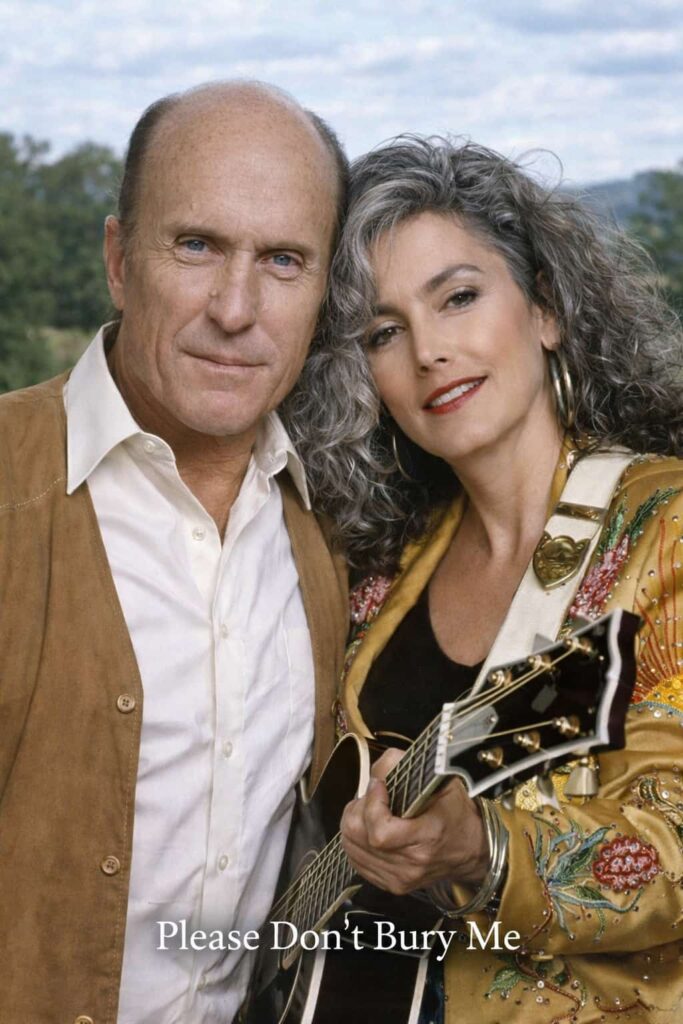
When “I Love To Tell the Story” is performed by Robert Duvall and Emmylou Harris, it is no longer just a traditional hymn—it becomes something far more intimate, almost like a whispered recollection of a life lived with quiet conviction. Their rendition appears on the soundtrack of the 1997 film The Apostle, a deeply personal project written, directed by, and starring Duvall himself. Unlike commercial singles of the era, this recording did not chart on mainstream rankings such as the Billboard Hot 100, yet its cultural and emotional resonance lies far beyond numerical success. It belongs instead to a tradition of spiritual music that transcends charts and trends.
The hymn itself dates back to the 19th century, with lyrics by Katherine Hankey and music composed by William Gustavus Fischer. Over generations, it has been sung in churches, gatherings, and quiet personal moments. But in the hands of Robert Duvall and Emmylou Harris, the song takes on a cinematic and emotional gravity that feels almost autobiographical—particularly within the context of The Apostle, a film about redemption, guilt, and the fragile hope for spiritual renewal.
Duvall, not widely known as a singer, delivers his lines with an unpolished sincerity. There is a trembling honesty in his voice—an almost spoken quality—that suggests this is not performance, but confession. Emmylou Harris, with her unmistakable, ethereal tone, provides a gentle counterbalance. Her voice does not overpower; it consoles. Together, they create a dialogue between struggle and grace, between doubt and belief.
What makes this rendition so compelling is its restraint. There are no grand arrangements, no orchestral swells designed to impress. Instead, the simplicity allows the listener to focus on the essence of the hymn’s message: the enduring need to share a story of faith, love, and redemption. In a world increasingly driven by spectacle, this quiet approach feels almost revolutionary.
The placement of the song within The Apostle is crucial. It does not merely accompany the narrative—it is the narrative. Duvall’s character, a deeply flawed preacher seeking redemption, finds in this hymn a form of expression that words alone cannot convey. The performance feels lived-in, shaped by experience rather than technique. One can sense the weight of years, of mistakes, of longing for forgiveness.
For Emmylou Harris, whose career has long been rooted in the traditions of country, folk, and gospel, this collaboration is a natural extension of her artistic identity. She has always had a gift for interpreting songs that carry emotional depth and historical resonance. Here, she becomes both witness and guide, leading the listener through the emotional landscape with quiet assurance.
The meaning of “I Love To Tell the Story” in this context shifts subtly but powerfully. It is no longer just about sharing a religious message; it becomes about the human need to make sense of one’s life, to find coherence in memory, and to pass that understanding on to others. The “story” becomes personal—each listener is invited to reflect on their own journey, their own moments of faith and doubt.
Listening to this version today, one cannot help but feel a sense of stillness, a pause in the noise of modern life. It recalls a time when music was not merely consumed, but felt—when a song could sit with you, quietly, and ask you to listen not just with your ears, but with your heart.
In the end, this recording stands as a testament to the enduring power of simplicity and sincerity. It reminds us that sometimes, the most profound musical experiences are not found in chart-topping hits, but in the quiet corners where truth is spoken softly, and where a simple story, told with honesty, can echo for a lifetime.