
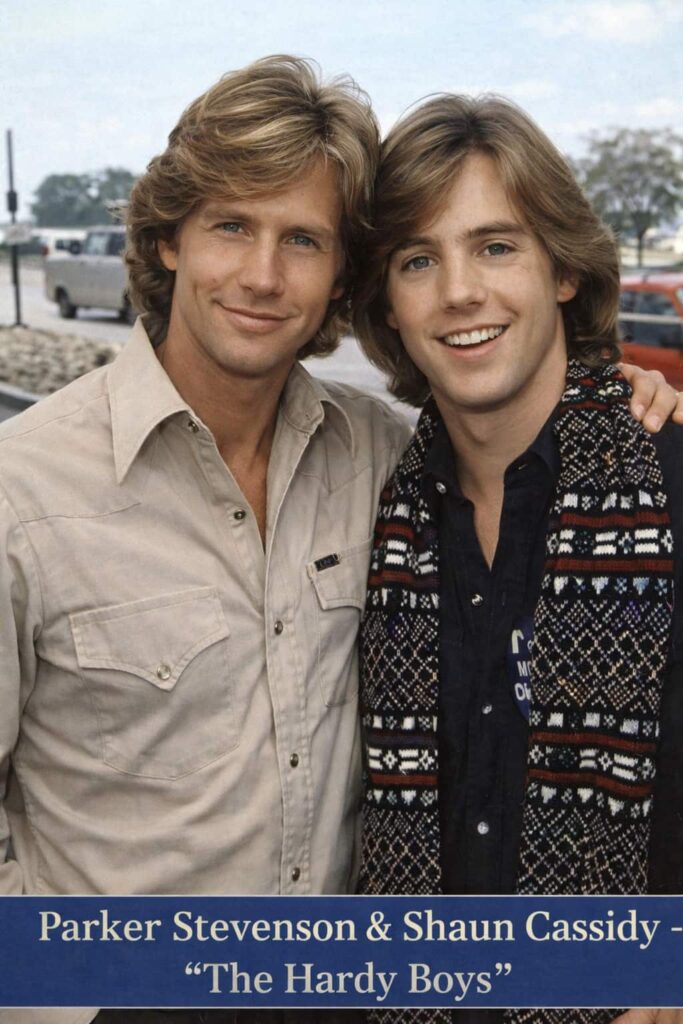
A Glimpse of Youthful Promise — The Screen Test That Sparked a Television Phenomenon
Long before the bright lights of prime-time success and the echo of devoted fans, there existed a simple yet quietly electric moment: the screen test of Parker Stevenson and Shaun Cassidy for the beloved television series The Hardy Boys/Nancy Drew Mysteries. What might have seemed like just another casting session in the mid-1970s would, in retrospect, become the foundation of one of television’s most enduring youth-oriented mysteries.
Premiering in 1977 on the ABC, the series quickly climbed the ratings, reaching impressive viewership and becoming a staple of family entertainment during its early seasons. While exact weekly rankings varied, the show consistently performed strongly enough to secure its place in prime-time scheduling—a testament to the chemistry first captured in that modest screen test.
The screen test itself is a fascinating artifact. Watching Parker Stevenson and Shaun Cassidy step into the roles of Frank and Joe Hardy, one can sense an immediacy—an unpolished yet sincere energy. Stevenson brought a calm, thoughtful presence, embodying the older brother’s quiet intelligence, while Cassidy radiated youthful charm and impulsiveness, perfectly balancing the duo. It was not merely acting; it felt like two young men discovering their characters in real time, almost as if the Hardy brothers had always existed within them.
Behind this moment lies a deeper story of timing and cultural mood. The late 1970s were a period when audiences longed for stories that combined innocence with adventure—narratives that could be shared across generations. The Hardy Boys, originally created by Edward Stratemeyer, had already lived in the imaginations of readers for decades. Yet it was this particular pairing—Stevenson and Cassidy—that translated those pages into something vividly human and emotionally accessible.
For Shaun Cassidy, this role came at a pivotal time. Already gaining attention as a pop singer, his casting bridged two worlds: music and television. His growing popularity helped draw younger audiences, while his natural screen presence ensured the role never felt like mere celebrity casting. Parker Stevenson, on the other hand, provided a grounding influence, his performance lending credibility and warmth to the series. Together, they created a dynamic that felt both aspirational and familiar.
The meaning of this screen test, when viewed today, goes beyond its immediate purpose. It represents the fragile beginning of something that would become deeply embedded in popular culture. There is a certain poignancy in seeing these early moments—before fame, before expectations, before the weight of success. It reminds us of a time when television was discovering new ways to connect with its audience, when stories were simpler yet somehow more resonant.
In many ways, the test embodies the essence of youth itself: tentative, hopeful, and filled with possibility. It is a snapshot of potential just before it transforms into legacy. For those who remember the series during its original run, revisiting this footage can feel like opening an old photo album—each frame carrying echoes of evenings spent in front of the television, of anticipation before each episode began.
Ultimately, the screen test of Parker Stevenson and Shaun Cassidy is not just a piece of casting history. It is a quiet beginning that speaks volumes—a reminder that even the most iconic partnerships often start in the simplest of rooms, under the soft glow of studio lights, with nothing more than a script, a camera, and the courage to believe in something yet unseen.