
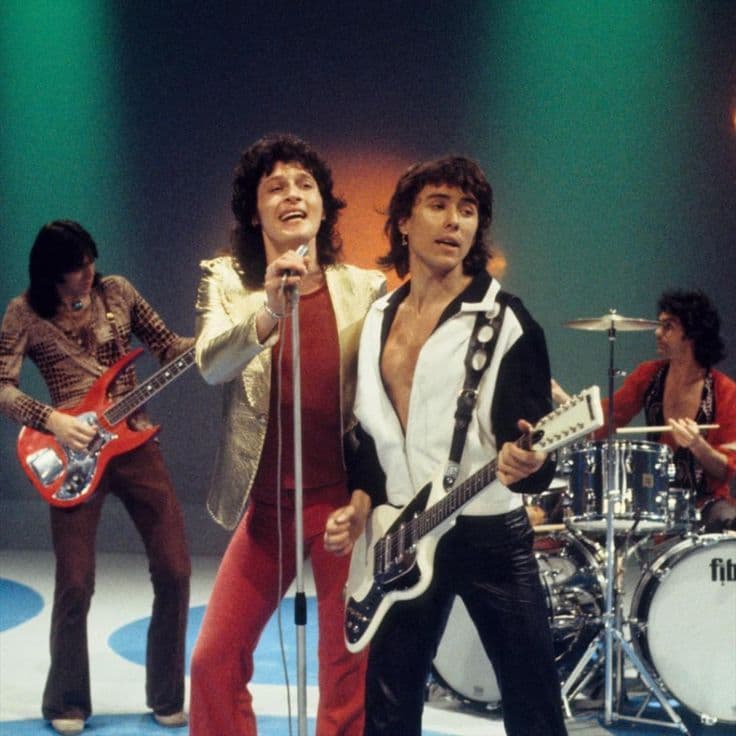
A Relentless Highway Anthem About Love, Distance, and the Invisible Signal Between Two Hearts
Few rock songs capture the feeling of the open road quite like “Radar Love” by Golden Earring. Released in 1973 as the lead single from the album Moontan, the song became the Dutch band’s international breakthrough. It climbed to No. 13 on the Billboard Hot 100 in the United States in early 1974, reached No. 7 in the UK Singles Chart, and hit No. 1 in the Netherlands, solidifying its place as one of the defining rock tracks of the decade. For a band that had been recording since the early 1960s, this was not an overnight success—it was the culmination of years spent refining their sound in clubs, on long tours, and in relentless studio sessions.
Written by guitarist George Kooymans and singer Barry Hay, “Radar Love” is built on one of the most iconic basslines in classic rock history, played by Rinus Gerritsen, and driven forward by the steady, muscular drumming of Cesar Zuiderwijk. From its opening pulse, the song feels like motion itself—an engine turning over in the night, headlights cutting through darkness, tires humming against asphalt. It is no surprise that the song became a staple of late-night radio and road-trip playlists across continents.
But beneath its driving rhythm lies a romantic concept that gives the song its lasting emotional power. The “radar love” in the title is not about technology—it is about intuition. It is the mysterious, almost psychic bond between two people who are far apart yet somehow connected. The narrator senses his lover’s call before it happens; she knows he is coming home. In the early 1970s, long before smartphones and instant communication, this idea resonated deeply. The song captures that old-world faith in connection—a belief that love could transcend miles and static and time itself.
There is also something quietly rebellious in its spirit. Golden Earring, unlike many of their British and American peers, came from The Hague, Netherlands. In an era dominated by Anglo-American rock acts, their success with “Radar Love” proved that rock and roll had truly become international. They toured extensively in the United States, sharing stages with major acts and earning respect through sheer musicianship. The extended live versions of the song—often stretching well beyond ten minutes—became showcases of instrumental interplay, improvisation, and raw energy.
The album Moontan itself deserves mention. Its original European cover art stirred controversy for its bold imagery, and the record carried a darker, more expansive sound than the band’s earlier work. Yet it was “Radar Love” that anchored the album commercially and emotionally. The song’s structure—tight verses, a soaring chorus, and that unforgettable mid-song instrumental break—creates a sense of journey. It is not just a track; it feels like travel.
Lyrically, the song speaks to longing, anticipation, and movement. The line “I’ve been driving all night, my hands wet on the wheel” evokes fatigue, determination, and desire all at once. There is romance in the risk, poetry in the persistence. It reflects a time when distance meant something tangible—when returning home required patience and endurance. The car becomes both a physical vehicle and a metaphor for commitment.
Over the decades, “Radar Love” has been covered and celebrated by artists ranging from U2 to White Lion, and it consistently appears on lists of the greatest driving songs in rock history. It has endured not because of nostalgia alone, but because it captures something universal: the feeling of moving toward someone who matters.
Listening to it today, one can almost hear the crackle of FM radio, feel the cool night air through an open window, and sense that old, stubborn optimism that love—real love—travels faster than doubt. That is the quiet genius of Golden Earring. They did not just write a hit single; they created a soundtrack for the long road home.