
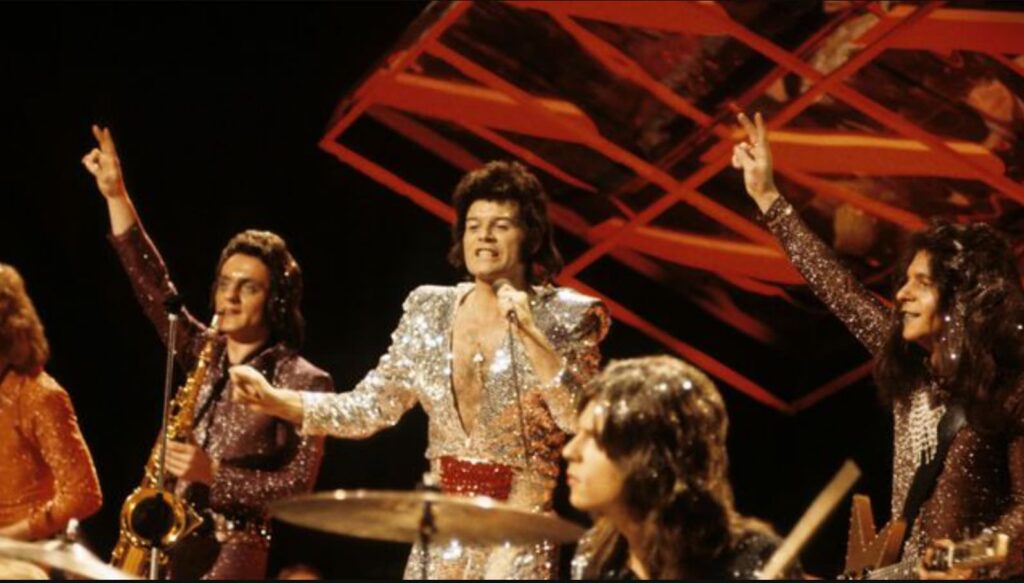
A Defiant Anthem of Self-Belief and Glam Rock Swagger That Once Ruled the Charts
When “Leader of the Gang (I Am)” burst onto the airwaves in 1973, it did not simply announce a song—it declared an identity. Performed by Gary Glitter, and released in July 1973 as a standalone single produced by the formidable songwriting team of Mike Leander and Gary Glitter himself, the track soared to No. 1 on the UK Singles Chart, holding the top position for four consecutive weeks. In Australia, it also reached No. 1, while in several European territories it enjoyed strong chart placements. This was glam rock at its loudest and most theatrical, a genre that reveled in spectacle and bold self-expression.
By the early 1970s, glam rock was already sparkling brightly, with artists like T. Rex and David Bowie shaping a flamboyant, glitter-dusted era of British pop. Yet Gary Glitter carved out his own niche—less mysterious than Bowie, less bohemian than Bolan, but unapologetically direct and brash. “Leader of the Gang (I Am)” became his signature declaration. It followed earlier hits like “Rock and Roll (Part 2),” but this was the song that fully cemented his persona: the leather-clad, stomping, chant-leading frontman who thrived on audience participation.
The structure of the song itself is deceptively simple. It opens with a pounding beat—almost tribal in its insistence—before Glitter’s voice cuts through: “Come on, come on!” That call-and-response energy defined its appeal. This was music meant for communal shouting, for packed halls where the crowd became part of the rhythm. The production, driven by Leander’s heavy drum patterns and handclaps, gave it an almost percussive dominance. It was not subtle music; it was bold, repetitive, and designed to stay lodged in memory.
Behind the swagger, however, lies an interesting cultural undercurrent. Early 1970s Britain was wrestling with economic strain and social uncertainty. Glam rock offered an escape—flashy, theatrical, rebellious, yet oddly innocent in its directness. “Leader of the Gang (I Am)” taps into that youthful desire for belonging, for recognition, for standing tall despite life’s turbulence. The lyric is not complex poetry, but its declaration—“Yes, I’m the leader of the gang”—carries a confidence that resonated widely. It was about identity, about self-proclamation in a world that often felt chaotic.
The song’s commercial triumph led to the release of the 1973 album “Touch Me”, which capitalized on the momentum of Glitter’s chart dominance. Concert performances during this period were electric. Glitter’s stage presence—platform boots, sparkling costumes, commanding gestures—transformed the song into a theatrical ritual. Audiences didn’t merely listen; they participated. In live settings, the chant-like chorus became almost hypnotic, reinforcing the sense of shared experience that defined much of early 1970s pop culture.
Musically, the track embodies glam rock’s essence: heavy drums, simple chord progressions, sing-along choruses, and a deliberate embrace of repetition. Critics at the time were divided. Some dismissed it as simplistic, yet others recognized its undeniable energy and craftsmanship. What cannot be denied is its cultural footprint. For many, the opening drumbeat alone can summon vivid memories—of transistor radios crackling in summer heat, of dance floors lit with colored bulbs, of youthful bravado echoing into the night.
Over time, public perception of Gary Glitter became deeply complicated for reasons unrelated to the music itself. Yet historically speaking, “Leader of the Gang (I Am)” remains a defining artifact of the glam era. It represents a moment when British pop embraced spectacle without apology, when music was loud, confident, and communal.
Listening to it today is like stepping into a time capsule. The stomping rhythm feels almost theatrical in its certainty. It reminds us of an age when a simple chant could unite a crowd, when bold self-assertion felt both daring and joyous. “Leader of the Gang (I Am)” is not merely a hit single—it is a vivid snapshot of 1973, of glam rock’s glittering peak, and of a musical moment that once seemed unstoppable.