
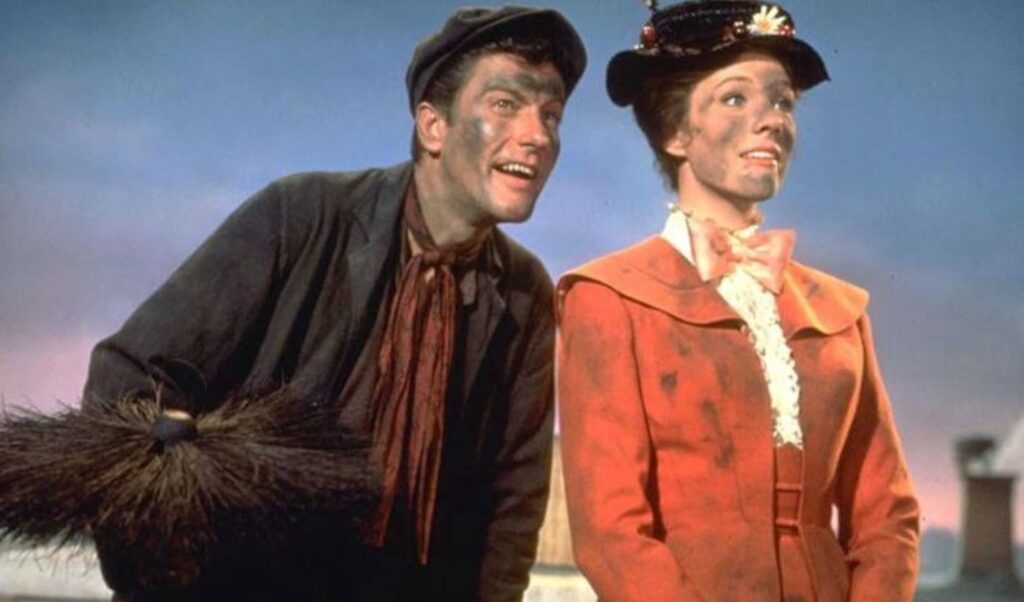
Chim Chim Cher-ee — a sooty little tune that carried hope, humility, and quiet wisdom above the London rooftops
There are songs that announce themselves with grandeur, and there are songs that arrive softly, like a kind word whispered on a gray morning. “Chim Chim Cher-ee”, sung by Dick Van Dyke in the role of Bert, belongs firmly to the second kind. Introduced to the world in 1964 through the film Mary Poppins, the song may sound playful at first, but beneath its gentle melody lies a philosophy of life that has endured for generations.
Let us place the important facts clearly at the start. “Chim Chim Cher-ee” was written by Richard M. Sherman and Robert B. Sherman, and first performed onscreen by Dick Van Dyke. It appeared on the Mary Poppins soundtrack, which reached No. 1 on the Billboard 200 in the United States and remained there for weeks during its original run. While Van Dyke’s version itself was not released as a chart-aimed pop single, the song achieved extraordinary recognition: in 1965, it won the Academy Award for Best Original Song, surpassing far more commercially aggressive contenders. That achievement alone secured its place in musical history.
But numbers and awards only tell part of the story.
In the film, Bert is a jack-of-all-trades — chimney sweep, street artist, storyteller — a man who lives on the margins yet sees the world with unusual clarity. When he sings “Chim Chim Cher-ee”, covered in soot and smiling through hardship, the song becomes a quiet anthem for dignity. The lyrics speak of luck, but not the flashy kind. They describe fortune as something that comes to those who endure, who keep their spirits intact even when life leaves them dirty and tired.
“Now as the ladder of life has been strung,
You may think a sweep’s on the bottommost rung…”
In these lines, the song gently reminds us that worth is not measured by position or appearance. The chimney sweep, often unseen and undervalued, becomes a symbol of resilience. It is a message delivered without bitterness — warm, slightly whimsical, and profoundly humane.
Dick Van Dyke’s performance is essential to why the song works so well. He does not sing it like a trained vocalist chasing perfection. Instead, he sings like a man telling a story. His voice carries friendliness, optimism, and just enough weariness to make the message believable. It is this sincerity that allows the song to transcend its role as a children’s tune and speak equally to adults who have lived long enough to recognize its truth.
Behind the scenes, the Sherman Brothers wrote the song as a thematic anchor for the entire film. “Chim Chim Cher-ee” appears in several variations throughout Mary Poppins, returning again and again like a familiar friend. Each reprise deepens its meaning, reinforcing the idea that joy can exist even in labor, and that kindness often comes from unexpected places.
For listeners encountering the song decades later, its charm has not faded. In fact, time has only enriched it. What once felt playful now feels wise. What once seemed simple now feels intentional. The melody lingers not because it demands attention, but because it offers comfort — a rare and precious quality.
In a world that often celebrates loud success, “Chim Chim Cher-ee” quietly honors endurance. It reminds us that even when we are covered in soot — literal or metaphorical — we may still be lucky, still valued, still capable of bringing light to others. That is why the song endures, and why Dick Van Dyke’s performance remains so deeply loved.
It is not just a song from a film. It is a gentle companion, walking beside us through memory, humming softly, reminding us that sometimes the truest wisdom comes from those who keep smiling while doing the hardest work of all: living with grace.