
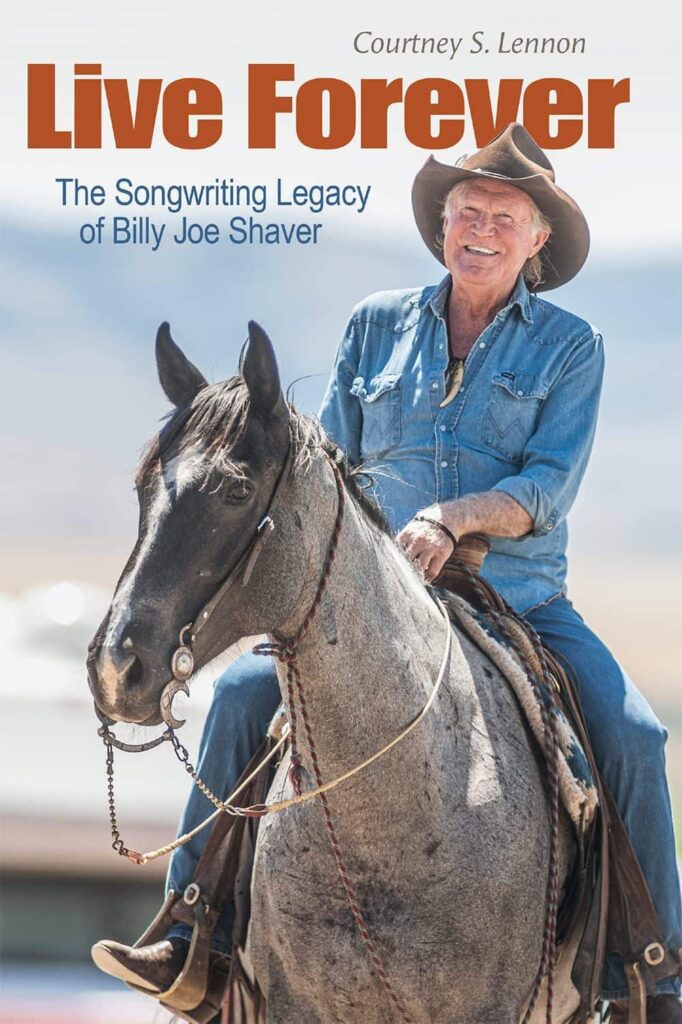
“Live Forever” — A tender hymn of love, loss and the promise of eternal return.
When reflecting on Live Forever, one is first struck by how quietly monumental it is in the catalogue of Billy Joe Shaver — a song that never once topped major charts, yet reverberates through time because of its deep emotional core and the life behind its creation.
Chart position
Despite being one of his most beloved songs, “Live Forever” did not achieve a significant placement on the major Billboard singles charts in a conventional way. It has been cited as a favourite among his fans and peers, but no official source shows a high-charting position on the Billboard Hot Country Songs chart.
The story behind the song
The creative origin of “Live Forever” is entwined with both familial love and heartbreaking loss. Billy Joe Shaver wrote the lyrics together with his son, guitarist Eddy Shaver, at a time when father and son were performing together under the name Shaver. Eddy provided the melody; Billy Joe held it close for nearly a year before the two developed the song’s spiritual and emotional themes.
Tragically, Eddy died in December 2000. In surviving him, Billy Joe later said, “His spirit’s still with me … I do believe that when people pass away, the goodness, the good things they did, it seems like they melt into your likeness.” In that light, “Live Forever” becomes more than a song: it becomes a testament, a memorial, an ongoing conversation between father and son, alive even in absence.
It is also worth noting that the song appeared in the 2009 film Crazy Heart (performed a cappella by actor Robert Duvall) — thereby reaching a broader audience beyond the world of country/folk.
The meaning of the song
At its heart, “Live Forever” is a love song — but not simply romantic love. It is a tender and humble promise of enduring connection: between lovers, between parent and child, between the living and the departed. The lyric reaches beyond the temporal:
“When this old world has blown asunder
And all the stars from fall this sky
Remember someone really loves you
We’ll live forever you and I”
This passage beautifully encapsulates the hope that even when the world as we know it is gone, love remains — transcendent, persistent. The lyric bears unmistakable traces of faith, acknowledging mortality yet embracing the possibility of eternal life, or at least, an eternal memory. The theme resonates especially with those who have experienced loss and wish for continuity beyond the immediate.
For older listeners — those who have loved, lost and kept living — the song holds extra weight. It speaks of resilience, of carrying forward someone’s melody even when the voice is silent. It invites us to remember that what we create, what we give, what we love, may last far beyond the years we walk under the sun.
Additional context and significance
Billy Joe Shaver belongs to the “outlaw country” movement of the 1970s — a movement that prized rawness, authenticity, and writing from lived experience rather than polished Nashville formula. His life was one of hardship and redemption: from picking cotton, surviving a sawmill accident (where he lost fingers), and a childhood without a father, to hitchhiking to Nashville and fighting to be heard. The fact that “Live Forever” comes from a prophet of that rough-and-ready terrain adds to its power — because here is a man who’s stared down the dark, and still sings of hope.
When you listen to the song, you hear more than just melody: you hear the echoes of the past, the rough edges of survival, the faith that quietly undergirds a life of scars and stories. For the mature listener, the resonance is deep. It is not about chart positions or radio spins; it is about meaning. And here, “Live Forever” has carved a meaningful niche in the lives of many.
Why it matters
- It reminds us that songwriting can be a legacy — an inheritance of words and melody, passed from father to son, from artist to audience, from one season of life to the next.
- It shows that love and loss are not opposites but companions: the more we love, the more we risk losing; the braver we are, the longer we carry.
- It offers a sense of continuity for those who have seen many sunsets and know that what we plant in the world may bloom after we are gone.
- It stands as a bridge between the personal and the universal: while the story belongs to Billy Joe and Eddy Shaver, the feeling belongs to anyone who has held someone dear and feared their departure.
In closing
If you close your eyes and allow the first chords of “Live Forever” to wash over you, you might feel something gentle yet unyielding: the memory of a time when a melody sat in a father’s pocket for a year, the hush of a son gone too soon, and the quiet vow that love will carry on. It is a song written in the spaces between heartbeat and silence, and it speaks not to youth but to experience — to the seasoned heart that understands: we may not live forever, but through our songs, our love, our memories — maybe we do.
In an era when so much music rushes past us, here is one that invites lingering. And for those who remember the long road, the songs that held them, the voices that echoed in the quiet hours — “Live Forever” offers solace, flame-bright hope, and the dignified whisper that we are not alone.