
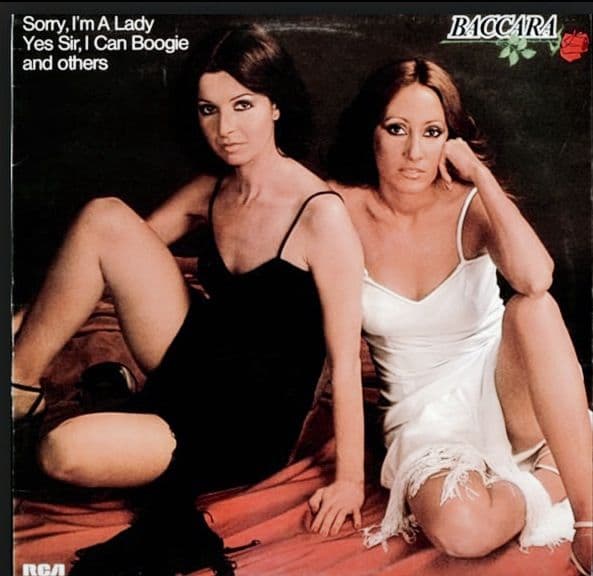
Yes Sir, I Can Boogie — a shimmering disco confession about desire, control, and the elegance of temptation
When “Yes Sir, I Can Boogie” first floated onto dance floors in 1977, it carried with it a very particular kind of magic — elegant, teasing, and quietly bold. Performed by the Spanish duo Baccara, the song was more than just a disco hit; it became a defining sound of late-1970s Europe, a slow-burn invitation wrapped in silky strings, restrained rhythm, and an unforgettable chorus that still lingers decades later.
From the outset, it is important to note the song’s remarkable impact. “Yes Sir, I Can Boogie” was released in 1977 as the debut single by Baccara, appearing on their first album Baccara (also known in some territories as Yes Sir, I Can Boogie). Upon release, it soared to No. 1 in the UK Singles Chart, holding the top position for three consecutive weeks, and became a chart-topper in more than a dozen countries across Europe. In the United Kingdom alone, it sold over one million copies, earning platinum status and securing its place as one of the best-selling singles of the decade. Few debut singles arrive with such confidence — fewer still leave such a lasting cultural imprint.
Behind the song were Dutch producers and songwriters Rolf Soja and Frank Dostal, who crafted a piece that deliberately avoided the high-energy frenzy common to much of disco at the time. Instead, they leaned into restraint. The rhythm is measured, almost languid. The melody glides rather than rushes. And over it all hover the voices of Mayte Mateos and María Mendiola, calm, controlled, and irresistibly poised.
Lyrically, the song is deceptively simple. A woman addresses a man who boasts of his prowess, his experience, his confidence. Her response is cool, self-assured, and quietly subversive: “Yes sir, I can boogie, but I need a certain song.” Beneath the surface, the meaning is unmistakable. She is not impressed by bravado alone. Desire, the song suggests, is not commanded — it is invited, negotiated, and ultimately chosen.
This perspective was subtle yet striking for its time. In an era when disco often celebrated excess and abandon, “Yes Sir, I Can Boogie” offered something different: control. The woman in the song is not swept away; she sets the terms. She acknowledges attraction but insists on her own rhythm, her own conditions. It is this quiet confidence — delivered without confrontation or drama — that gives the song its enduring sophistication.
The story of Baccara themselves adds another layer of fascination. Mayte and María met while working in the Spanish entertainment world and were later discovered by Soja and Dostal, who envisioned a duo that blended European glamour with an international sound. Their visual presentation — coordinated outfits, graceful movements, and an air of mystery — became inseparable from the music. They did not shout for attention; they drew it in.
For many listeners, hearing “Yes Sir, I Can Boogie” now is like opening a time capsule. The song recalls softly lit dance halls, slow spins under mirrored balls, and the particular intimacy of disco’s quieter moments — when movement was less about spectacle and more about connection. It evokes a period when style mattered, when elegance could be sensual, and when a song didn’t need to hurry to make its point.
Over the years, the track has enjoyed an extraordinary afterlife. It has been rediscovered by new generations, sampled, covered, and famously embraced by unexpected audiences — including sports fans who turned it into an anthem decades after its release. Yet none of these revivals diminish its original charm. If anything, they confirm its timelessness.
Ultimately, “Yes Sir, I Can Boogie” endures because it speaks softly and confidently about desire — not as something loud or reckless, but as something knowing. It reminds us of a time when pop music could be both accessible and refined, playful yet thoughtful. And when those opening lines return, floating effortlessly through the air, they don’t just invite us to dance — they invite us to remember.