
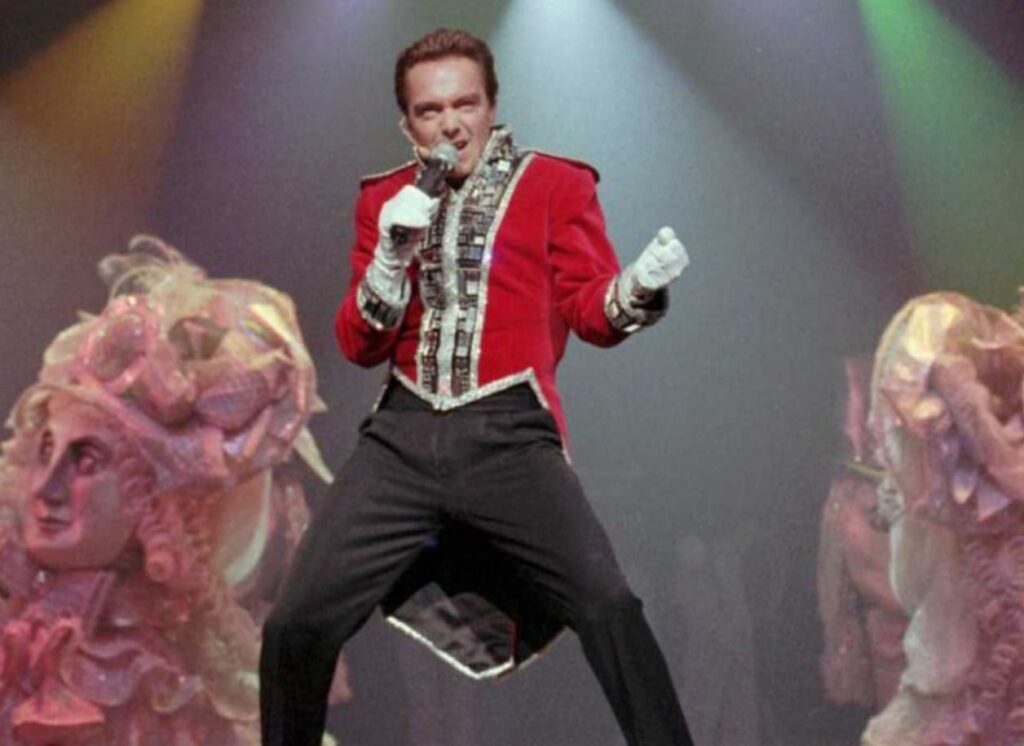
A forgotten television special that revealed how far David Cassidy had traveled — from teen idol hysteria to a quieter search for meaning beneath the lights of Las Vegas.
By 2002, the world no longer saw David Cassidy the way it had in the early 1970s. The screaming crowds had faded into memory, the magazine covers belonged to another era, and the boy who once seemed trapped inside the machinery of fame had become something more reflective, more weathered, and perhaps more honest. That is what made “David Cassidy’s Las Vegas”, the Travel Channel special aired in 2002, such an unexpectedly moving piece of television. It was not simply a celebrity tour of casinos and neon signs. It became, in many ways, a portrait of survival.
For audiences who remembered The Partridge Family, the special carried an emotional weight that younger viewers may not have fully understood. Here was a man who had once stood at the absolute center of pop culture. During the early 1970s, David Cassidy was one of the biggest stars on earth. Songs like “I Think I Love You” reached No. 1 on the Billboard Hot 100 in 1970, while hits such as “Cherish”, “How Can I Be Sure”, and “Daydreamer” turned him into a global phenomenon. Stadiums filled with fans. Television networks built programming around him. His face became part of the visual language of the decade itself.
Yet fame had always been complicated for Cassidy. Behind the smiles and carefully manufactured image was a performer who desperately wanted to be taken seriously as a musician. He often spoke openly about the exhaustion of being marketed as a teen fantasy while trying to grow into adulthood under the public eye. By the time the 1980s and 1990s arrived, Cassidy had already experienced the brutal emotional comedown that so many young stars endure after the spotlight shifts elsewhere.
That is why the 2002 Las Vegas special feels strangely intimate today.
Las Vegas itself had long represented reinvention for entertainers of Cassidy’s generation. It was the city where performers could rebuild careers, reconnect with audiences, and sometimes rediscover themselves. For legends from Elvis Presley to Tom Jones, Vegas became more than a workplace — it became a second act. In Cassidy’s case, the city offered something deeply symbolic: a chance to stand onstage again, not as a manufactured teenage product, but as a seasoned performer with scars, memories, and hard-earned perspective.
The special followed Cassidy through the rhythm of Las Vegas entertainment culture, showing rehearsals, performances, backstage conversations, and the exhausting reality behind the glamour. What made it compelling was not spectacle, but vulnerability. There was a quiet weariness in him at times, but also professionalism and resilience. He understood entertainment as labor now, not fantasy.
And perhaps that honesty is what resonates most strongly today.
Unlike the carefully polished television appearances of his youth, this special allowed glimpses of the man behind the mythology. Cassidy spoke not only about performing, but about longevity — about staying relevant in an industry that often discards its former idols once youth disappears. There was no bitterness in his presence, only the unmistakable awareness of someone who had lived through the unpredictable emotional cost of celebrity.
Musically, Cassidy’s Las Vegas years also reflected his broader artistic identity. While mainstream America still largely associated him with bubblegum pop, his deeper influences had always leaned toward rock, soul, and singer-songwriter traditions. He admired artists who conveyed emotional truth, and during live performances in this period, his voice often carried a rougher, more lived-in quality than the pristine recordings of the 1970s. Age had changed the instrument, but it had also deepened it.
That contrast gave the Travel Channel special its emotional texture. The bright casinos and glowing marquees stood beside memories of lost innocence. Vegas became almost metaphorical — a city built on illusion hosting a performer who had spent decades trying to escape one.
There is also something profoundly touching about revisiting Cassidy during this stage of his life knowing what later years would bring. Long before his passing in 2017, there was already a reflective sadness surrounding him, as though he understood how fleeting fame truly was. Yet he never entirely stopped performing. That persistence mattered. It revealed how deeply music remained connected to his identity.
For many viewers, the special stirred memories not only of Cassidy himself, but of an entire era when pop music felt more personal, more innocent, and somehow woven directly into everyday life. Songs were attached to first loves, family living rooms, transistor radios, and distant summers that now seem impossibly far away.
Watching David Cassidy walk through Las Vegas in 2002 was therefore more than nostalgia. It was witnessing someone carry the weight of his own cultural history while still trying to move forward. And in that sense, the special quietly became one of the most human chapters of his long and complicated career.