
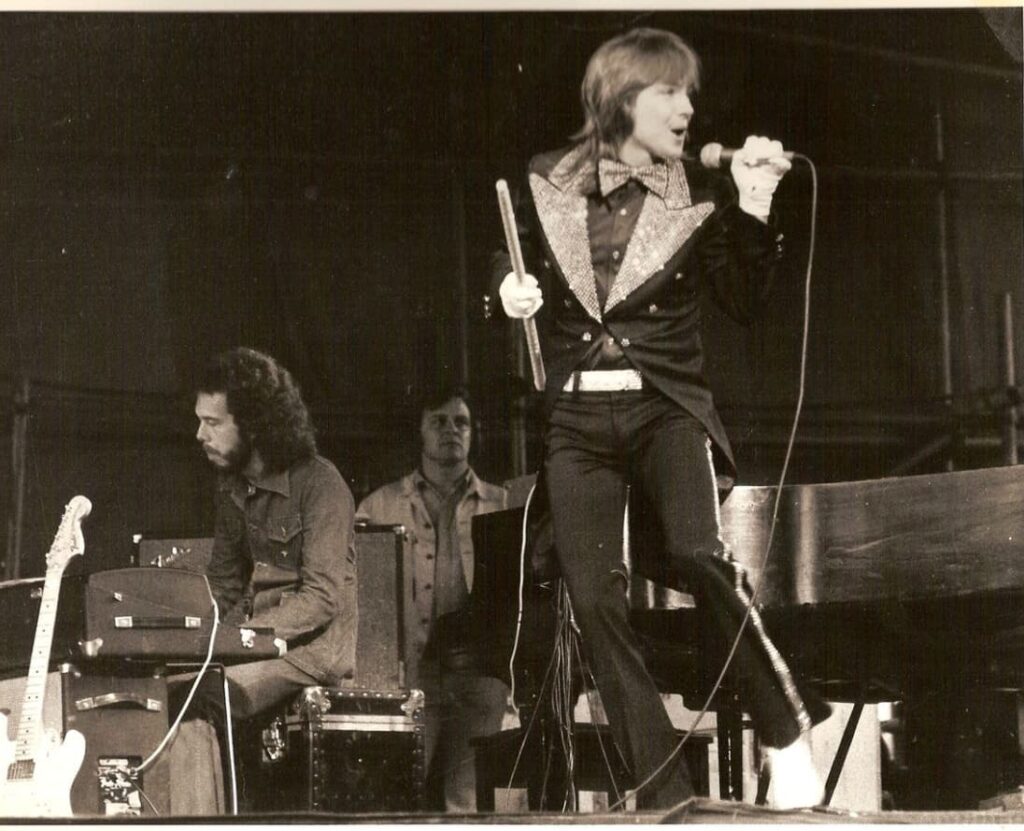
A Night When Teen Idolatry Became Something Larger Than Fame
On May 26, 1974, David Cassidy stood before tens of thousands at London’s legendary White City Stadium — and for one unforgettable evening, the screaming, the emotion, and the loneliness behind superstardom all seemed to collide in a single moment.
By the spring of 1974, David Cassidy was no longer simply the charming face from The Partridge Family. He had become a cultural storm. In both the United States and the United Kingdom, his popularity had reached a level few young performers could truly understand, and perhaps even fewer could survive emotionally. The concert at White City Stadium in London on May 26, 1974, captured that strange and fragile peak better than almost any photograph or television appearance ever could.
At the time, Cassidy was only 24 years old, yet he was carrying the weight of a phenomenon that had spiraled far beyond music itself. His records were topping charts across Europe and Australia, magazines printed his face weekly, and stadium crowds reacted to him with an intensity more commonly associated with political movements or religious revivals. Songs like “Daydreamer,” “How Can I Be Sure,” “Cherish,” and “Rock Me Baby” had already cemented his place among the defining pop voices of the early 1970s.
Particularly in the UK, Cassidy’s success was extraordinary. “Daydreamer” reached No. 1 on the UK Singles Chart in 1973, while “How Can I Be Sure” also climbed to No. 1 later that same year. His album Dreams Are Nuthin’ More Than Wishes became another major success, confirming that British audiences were embracing him not merely as a television celebrity, but as a genuine recording artist. That distinction mattered deeply to Cassidy, because behind the fame was a young musician desperately trying to be taken seriously.
The White City Stadium concert became one of the defining live moments of that era. Reports from the time described scenes of overwhelming excitement: deafening screams, emotional collapses in the audience, and security struggling to maintain order as fans surged toward the stage. Yet what makes this concert fascinating decades later is not merely the hysteria — it is the contrast between the public celebration and the private exhaustion Cassidy was beginning to feel.
Looking back now, the performance almost feels bittersweet.
Onstage, he projected confidence and warmth, smiling through wave after wave of adoration. But offstage, Cassidy had already started speaking openly about the emotional toll of fame. He often admitted that the image forced upon him — the carefully manufactured teen idol — trapped him creatively. He admired serious artists like The Beatles, The Rolling Stones, and Joni Mitchell, and he longed to grow beyond the screaming audiences that sometimes drowned out the very songs he was trying to perform.
That tension gave the White City concert its emotional depth.
Because beneath the excitement was a young man trying to hold onto his identity while the world treated him like a fantasy. Cassidy later revealed that many nights during those peak touring years felt isolating despite the enormous crowds. The louder the audience screamed, the harder it sometimes became for him to communicate as an artist. In many ways, the White City performance represented both the absolute height of his fame and the beginning of his desire to escape it.
And perhaps that is why the concert continues to resonate emotionally today.
For many who remember that era, David Cassidy represented youth in its most fleeting form — hopeful, emotional, energetic, and impossible to preserve. Watching footage or photographs from that London performance now feels less like revisiting a pop concert and more like opening a time capsule from the early 1970s itself. The hairstyles, the homemade signs, the emotional intensity in the crowd — all of it reflects a period when music fandom still carried innocence, before celebrity culture became cynical and carefully calculated.
What also made Cassidy unique was that he possessed genuine musical ability often overlooked because of his image. His phrasing, vocal control, and sensitivity to melody were stronger than critics sometimes admitted during his commercial peak. Songs performed during the White City era revealed influences from soft rock, blue-eyed soul, folk-pop, and even country-pop traditions that were becoming increasingly popular during the decade.
In hindsight, the concert stands not merely as a triumph of popularity, but as a portrait of the complicated cost of being adored by millions.
Many stars experience fame. Very few become symbols of an entire emotional generation.
That night in London, under the stadium lights of White City, David Cassidy was not simply performing songs. He was carrying the dreams, heartbreaks, fantasies, and memories of countless young listeners who saw part of themselves in him. Decades later, the noise of that crowd may have faded, but the emotional echo of that evening still lingers — gentle, distant, and impossibly human.