
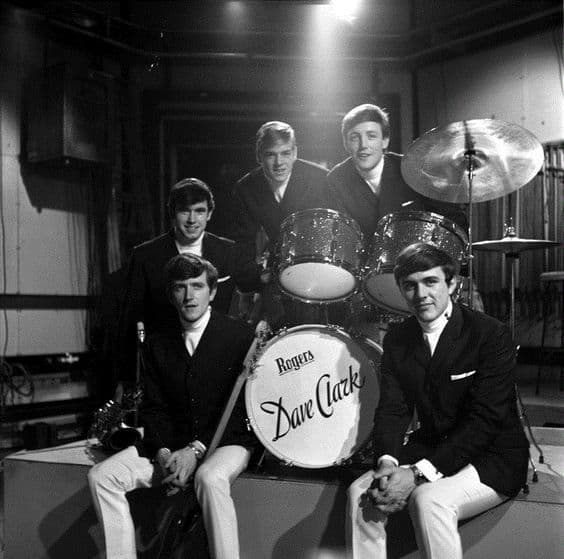
A burst of youthful defiance and joy—“Glad All Over” captures the moment when British rock broke free and shouted back at the world.
When The Dave Clark Five released “Glad All Over” in late 1963, few could have predicted just how disruptive its impact would be. In January 1964, the song climbed to No. 1 on the UK Singles Chart, famously knocking The Beatles’ “I Want to Hold Your Hand” off the top spot—an achievement that, at the time, felt almost unthinkable. Across the Atlantic, it reached No. 6 on the Billboard Hot 100, helping to cement the band’s place in the early wave of the British Invasion. Those chart positions were more than numbers; they marked a shift in sound, energy, and attitude.
From its very first seconds, “Glad All Over” announces itself with a pounding, almost tribal drumbeat—driven by Dave Clark himself—that feels raw, urgent, and unmistakably different from the polished pop that dominated the airwaves. Then come the handclaps, the call-and-response vocals, and that infectious shout: “You say that you love me…” It wasn’t just a song—it was an experience, one that seemed to leap out of transistor radios and into crowded dance halls.
The story behind the song is as compelling as its sound. Written by band members Dave Clark and Mike Smith, “Glad All Over” was crafted to capture the electricity of their live performances. The Dave Clark Five were known for their powerful stage presence, often louder and more physically dynamic than many of their contemporaries. Unlike the more melodic and harmonically intricate approach of The Beatles, DC5 leaned into rhythm, volume, and sheer exuberance. The song was designed not just to be heard, but to be felt—something that becomes clear with every beat of Clark’s drums and every enthusiastic vocal from Smith.
There is also a deeper meaning beneath the surface of its seemingly simple lyrics. At its heart, “Glad All Over” is a declaration of emotional liberation. It’s about the overwhelming joy of love returned, of no longer holding back, of allowing oneself to feel completely and openly. In a time when the world was still emerging from post-war austerity, that kind of emotional openness carried a quiet significance. It wasn’t introspective or poetic in the traditional sense—it was direct, almost primitive in its honesty. And perhaps that’s why it resonated so widely.
The recording itself reflected a certain independence that set the band apart. Dave Clark, acting as both drummer and de facto producer, maintained tight control over the group’s sound and business decisions—an unusual move in an era when artists were often at the mercy of producers and record labels. That independence gave The Dave Clark Five a distinct identity: bold, self-assured, and unapologetically loud.
Listening to “Glad All Over” today, one can still feel the immediacy of its energy. It doesn’t rely on complex arrangements or elaborate production tricks. Instead, it thrives on something far more enduring—the pure thrill of a band playing together with conviction and joy. There’s a sense of togetherness in the performance, as if every clap, every shout, every drumbeat is part of a shared moment that refuses to fade.
In the broader landscape of 1960s music, the song stands as a reminder that the British Invasion was never a one-band story. While The Beatles may have led the charge, bands like The Dave Clark Five ensured that the movement had depth, diversity, and a healthy sense of competition. “Glad All Over” wasn’t just a hit—it was a statement. A declaration that there was more than one voice coming out of Britain, and that each had something vital to say.
And perhaps that is why, decades later, the song still carries a certain spark. It brings back the echo of crowded rooms, spinning records, and a time when music felt like it could change the mood of an entire generation in just under three minutes. A simple song, yes—but one that remains, in every sense, glad all over.