
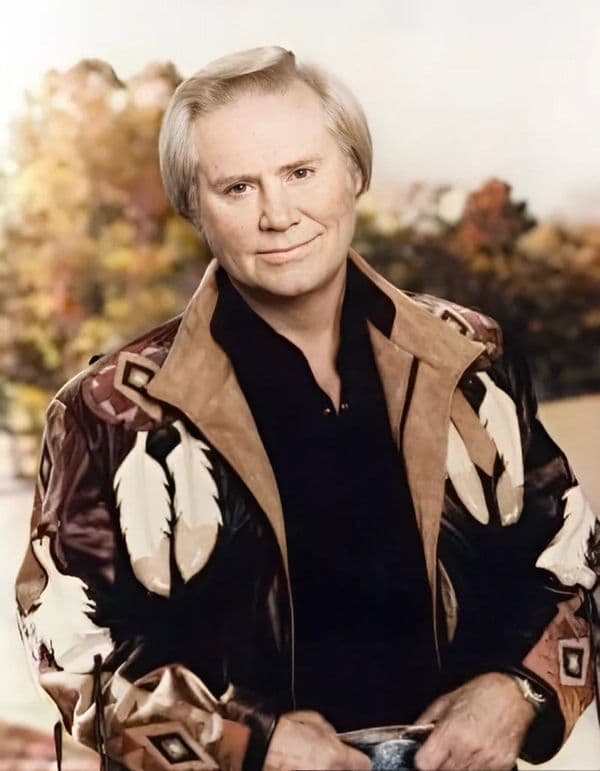
When heartbreak refuses to fade, even the strongest man finds himself losing to memories he cannot outrun.
Released in early 1980, “If Drinkin’ Don’t Kill Me (Her Memory Will)” by George Jones arrived at a moment when country music was quietly shifting its emotional vocabulary—becoming more introspective, more brutally honest about human frailty. The song climbed to No. 8 on the Billboard Hot Country Singles, a respectable position, though its impact has proven far more enduring than its chart peak might suggest. It was included on the album I Am What I Am, a title that, in hindsight, feels less like a statement and more like a confession.
By 1980, George Jones was not merely a singer interpreting heartbreak—he was living it, embodying it, and in many ways, being consumed by it. His struggles with alcoholism were no secret, and the collapse of his marriage to Tammy Wynette still lingered like an open wound. In that context, “If Drinkin’ Don’t Kill Me (Her Memory Will)” doesn’t feel like a performance; it feels like a man documenting his own slow unraveling.
The song itself is deceptively simple in structure. There are no grand metaphors, no elaborate poetic turns. Instead, it leans on stark, conversational honesty. The narrator isn’t searching for redemption—he’s acknowledging defeat. The central line, almost chilling in its clarity, suggests that even self-destruction through alcohol might not be enough to erase the torment of memory. And that is where the song finds its devastating power: not in what is said, but in what is quietly accepted.
Musically, the arrangement is restrained, allowing George Jones’ voice to carry the emotional weight. There is a certain fragility in his delivery—his phrasing slightly delayed, his tone wavering just enough to suggest exhaustion rather than theatrical sorrow. This is not the polished heartbreak of Nashville’s golden era; this is something rawer, closer to the bone. The steel guitar weaves gently through the track, not to decorate but to echo the loneliness embedded in every line.
What makes this recording particularly haunting is how closely it mirrors Jones’ real-life narrative. Around this period, he was deep in what many would later call his “lost years,” a time marked by erratic performances, missed shows, and personal decline. Yet, paradoxically, it was also a time when his artistry reached a kind of unfiltered authenticity. Songs like this did not require imagination—they required survival.
There is also a broader cultural resonance to consider. Country music has long been a genre unafraid to confront pain, but “If Drinkin’ Don’t Kill Me (Her Memory Will)” strips away even the small comforts typically offered—there is no moral lesson, no sense of closure. It presents heartbreak as something permanent, something that lingers long after the relationship itself has ended. In doing so, it speaks to a universal experience: the realization that some wounds do not heal, they simply become part of who we are.
Looking back today, the song stands as one of the clearest windows into George Jones’ artistry during a turbulent chapter of his life. It reminds us that the greatest country music often comes not from storytelling alone, but from truth—unvarnished, uncomfortable, and deeply human. And perhaps that is why it continues to resonate: because it does not pretend that time or distance can fix everything. Sometimes, memory is the heavier burden… and sometimes, it is the one thing you cannot escape.