
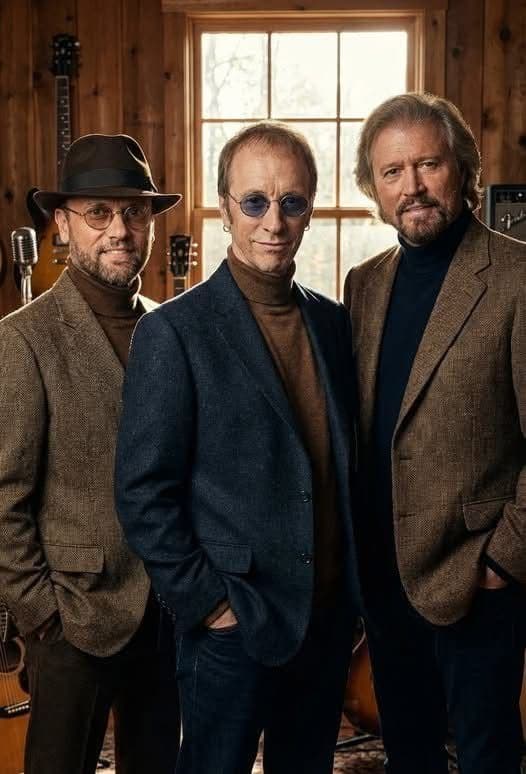
A song born from longing and loss, “To Love Somebody” captures the quiet ache of giving everything… and still not being understood.
When Bee Gees released “To Love Somebody” in 1967, it wasn’t just another entry in the flourishing catalog of late-’60s pop—it was a deeply personal statement wrapped in a deceptively simple melody. Featured on their album “Bee Gees’ 1st,” the song reached No. 17 on the Billboard Hot 100, a respectable position at the time. Yet, chart numbers alone fail to explain the enduring emotional gravity this song would carry across decades.
The story behind “To Love Somebody” is as poignant as the song itself. Written by Barry Gibb and Robin Gibb, it was originally intended for Otis Redding, whose raw, soulful delivery would have given the song a different—but perhaps equally powerful—life. Tragically, Redding died in a plane crash in December 1967 before he could record it. In a sense, the Bee Gees’ own version became both a tribute and a quiet farewell to what might have been. Knowing this adds an almost spectral layer to the song; every note seems to carry an echo of absence.
Musically, the track stands apart from the more ornate pop productions of its era. Built around a steady rhythm and a restrained arrangement, it allows Barry Gibb’s lead vocal to take center stage. His voice doesn’t soar in flamboyance—it aches. There’s a deliberate restraint, a sense that the emotion is being held back just enough to remain dignified, yet impossible to ignore. That balance is what gives the performance its timeless quality.
Lyrically, “To Love Somebody” speaks in plain, almost conversational language. There are no elaborate metaphors, no poetic flourishes that demand interpretation. Instead, it presents a simple, universal truth: loving someone deeply does not guarantee that love will be returned—or even understood. Lines like “You don’t know what it’s like, baby, you don’t know what it’s like” resonate because they feel lived-in, as though they’ve been carried quietly for years before being set to music. It’s a confession, not a performance.
In the broader context of the Bee Gees’ career, this song represents an early peak of emotional maturity. Before the glittering era of disco fame that would later define them in the public imagination, there was this: a moment of introspection, of vulnerability, of pure songwriting craft. It reminds listeners that beneath the polished harmonies and commercial success, the Bee Gees were, at their core, storytellers of the human condition.
Over the years, “To Love Somebody” has been covered by countless artists, each drawn to its emotional honesty. Yet, the original recording retains a certain intimacy that is difficult to replicate. Perhaps it’s the knowledge of its intended recipient, or the historical moment in which it was created—a time when music often served as both personal expression and collective solace.
Listening to the song now, one can’t help but feel that it exists slightly outside of time. It doesn’t belong solely to 1967, nor to any particular generation. It belongs to anyone who has ever loved deeply, silently, and without certainty. And in that quiet universality, “To Love Somebody” continues to speak—softly, but with unwavering clarity.