
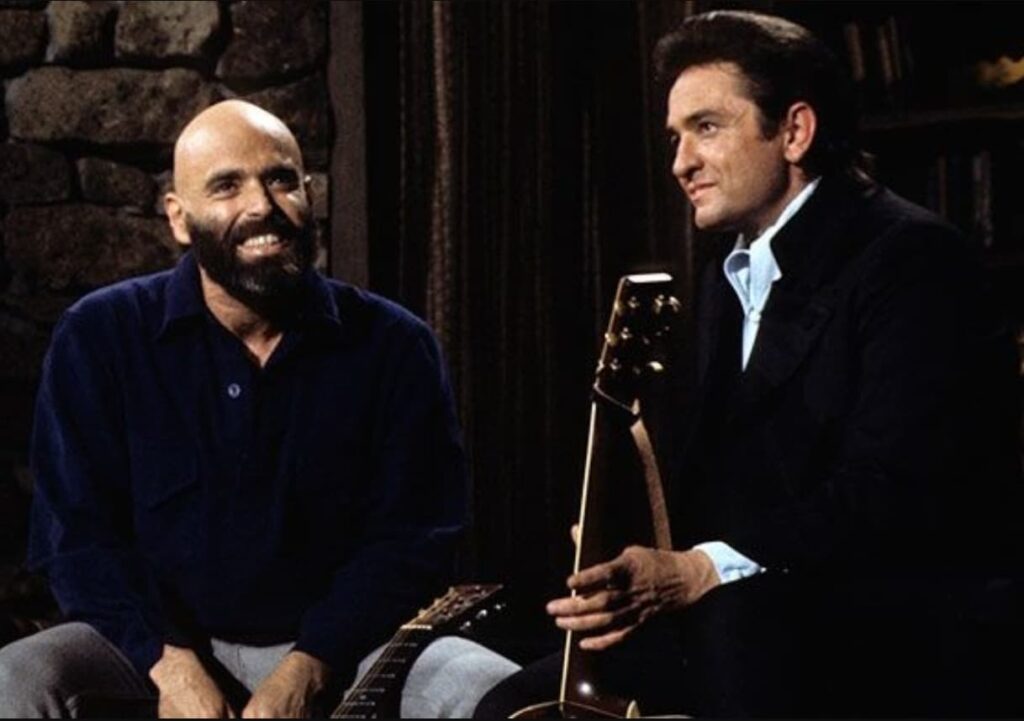
A song that turns ridicule into resilience—where laughter masks pain, and a strange name becomes a man’s making
When Johnny Cash stepped onto the stage at San Quentin State Prison in 1969, few could have predicted that one of the most unforgettable moments of his career would come from a humorous, rough-edged tale about a boy burdened with an unfortunate name. Yet “A Boy Named Sue”—written by the poet Shel Silverstein—became exactly that: a performance that felt spontaneous, electric, and deeply human. Released as part of the live album At San Quentin, the song quickly climbed the charts, reaching No. 2 on the Billboard Hot 100 and No. 1 on the country charts, marking one of Cash’s biggest crossover successes.
What makes “A Boy Named Sue” endure is not merely its humor, but the tension beneath it—the sense that behind every laugh lies a wound not quite healed. Cash himself had only received the song shortly before the concert and performed it live without rehearsal, reading some of the lyrics from cue cards. That rawness is palpable. You can hear the audience—prison inmates—responding instinctively, laughing, cheering, recognizing something of themselves in the story of a man shaped by hardship.
At its core, the song tells of a young man who grows up resenting his absent father for giving him a name that subjects him to ridicule. “Sue,” a name that invites mockery, becomes both a curse and a strange kind of armor. The boy learns to fight, to harden himself, to survive in a world that offers little kindness. When he finally confronts his father in a barroom showdown, what unfolds is not just a brawl, but a reckoning—a moment where anger meets understanding.
Shel Silverstein’s writing is deceptively simple. Beneath the humor and the barroom bravado lies a profound meditation on identity and resilience. The father’s explanation—that he gave his son that name to ensure he would grow up tough—introduces a complicated moral ambiguity. Was it cruelty, or a twisted form of love? Cash delivers this revelation with a mix of grit and tenderness, allowing the listener to sit with that discomfort.
For Johnny Cash, a man who often sang about outcasts, prisoners, and the overlooked corners of American life, “A Boy Named Sue” fits seamlessly into his artistic identity. Yet it stands apart because of its tone. Unlike the solemn weight of songs like Folsom Prison Blues, this track leans into humor without losing emotional depth. It shows Cash’s ability to balance lightness and gravity—a rare gift.
The success of the song also reflects a particular moment in time. The late 1960s were filled with cultural upheaval, and audiences were drawn to authenticity, to voices that felt real and unpolished. A live recording from a prison, filled with laughter, profanity (which was notably censored in the single version), and raw storytelling, felt refreshingly honest. It wasn’t polished Nashville—it was something more immediate, more alive.
Listening today, “A Boy Named Sue” carries a certain nostalgia—not just for an era, but for a style of storytelling that trusted the listener to find meaning between the lines. It reminds us that strength often comes from unlikely places, and that even the things we resent most about our past can shape us in ways we only understand much later.
And perhaps that is why the song still resonates. It is not just about a name. It is about the long road to self-acceptance, about the complicated legacies we inherit, and about the quiet moment when anger softens into something closer to forgiveness.