
A Playful Yet Piercing Portrait of Love’s Confusion and the Gentle Madness It Brings
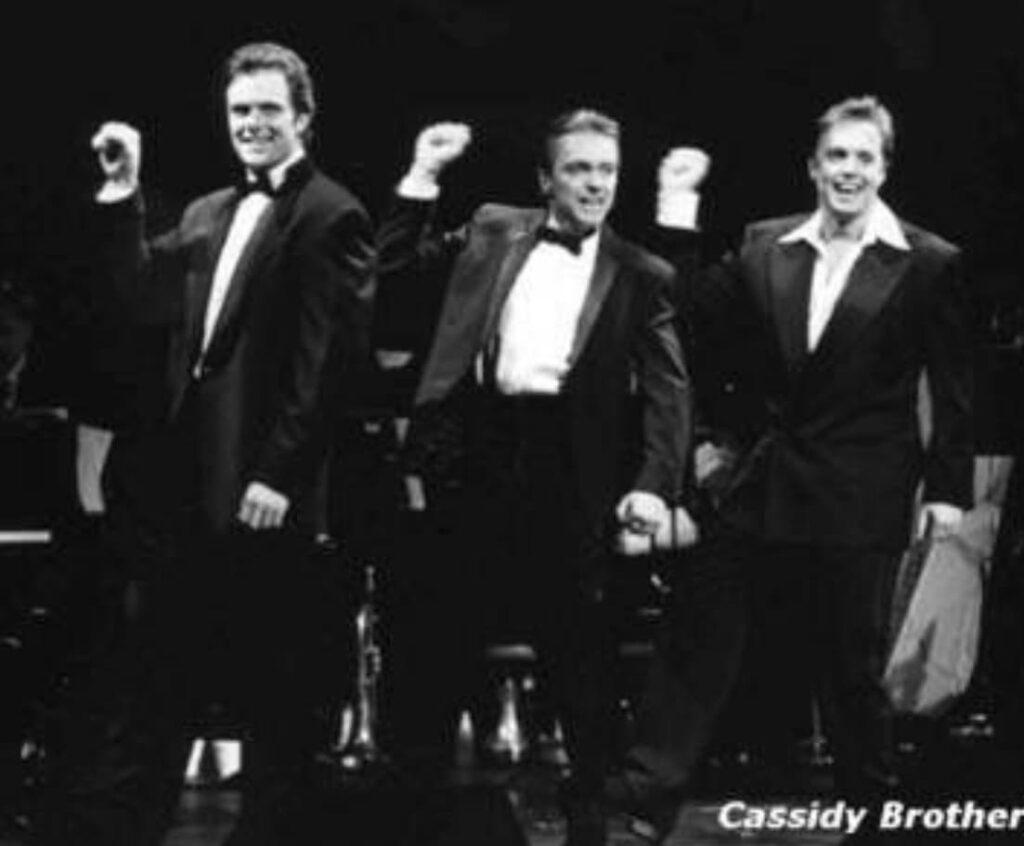
In the long and often intertwined story of the Cassidy family, few performances capture their shared musical spirit quite like “You Could Drive a Person Crazy” by The Cassidy Brothers — David, Shaun, and Patrick Cassidy. Though not released as a major charting single in the traditional sense, this number gained recognition through stage and television performances, where its charm, wit, and tight vocal harmonies left a lasting impression on audiences who had followed the Cassidys from their individual successes into this rare collective moment.
Originally written by the legendary Stephen Sondheim for the 1971 musical Company, the song itself carries a theatrical pedigree. In its original context, it was a witty and rhythmically intricate trio performed by three women commenting on the emotional evasiveness of a man unable to commit. When reinterpreted by David Cassidy, Shaun Cassidy, and Patrick Cassidy, the piece took on an entirely new dimension—transforming from a sharp Broadway commentary into something more familial, playful, and unexpectedly heartfelt.
By the time this collaboration came into public view, David Cassidy had already cemented his legacy as a teen idol through The Partridge Family, scoring multiple hits on the Billboard Hot 100, including the No. 1 smash “I Think I Love You” in 1970. His younger brother, Shaun Cassidy, followed closely behind with his own wave of success, most notably with “Da Doo Ron Ron,” which also reached No. 1 on the Billboard Hot 100 in 1977. Patrick Cassidy, though less associated with pop charts, had built a respected career in theatre and television, making him perhaps the most directly connected to the song’s Broadway origins.
This convergence of paths is what gives “You Could Drive a Person Crazy” its deeper resonance. While it may appear lighthearted on the surface—with its quick tempo, clever phrasing, and almost mischievous tone—the song speaks to a universal truth about relationships: the quiet frustration of mixed signals, the longing for clarity, and the emotional fatigue of loving someone who cannot fully give themselves in return.
In the hands of the Cassidy brothers, however, these themes are softened by a sense of camaraderie. Their version feels less like a complaint and more like a knowing smile—a shared acknowledgment of life’s romantic absurdities. There is an ease in their harmonies that suggests not just professional polish, but a lifetime of shared experience. One can almost hear the echoes of childhood, of growing up in a household where music was not merely a profession, but a language spoken daily.
The absence of a formal chart position does not diminish the cultural value of this performance. In fact, it enhances its intimacy. This was not a song chasing commercial success; it was a moment—fleeting, genuine, and deeply rooted in both theatrical tradition and family connection. For those who remember the era of variety shows and live television performances, it recalls a time when such collaborations felt spontaneous and sincere, unburdened by the machinery of modern promotion.
What lingers most, perhaps, is the sense of legacy. “You Could Drive a Person Crazy” becomes, in this context, more than just a clever composition by Stephen Sondheim. It becomes a bridge—linking Broadway to pop culture, individual fame to collective memory, and three brothers to a shared artistic expression that transcends charts and statistics.
And in that gentle interplay of voices, one finds not only humor, but a quiet reflection on love itself: unpredictable, occasionally exasperating, yet always worth the song.