
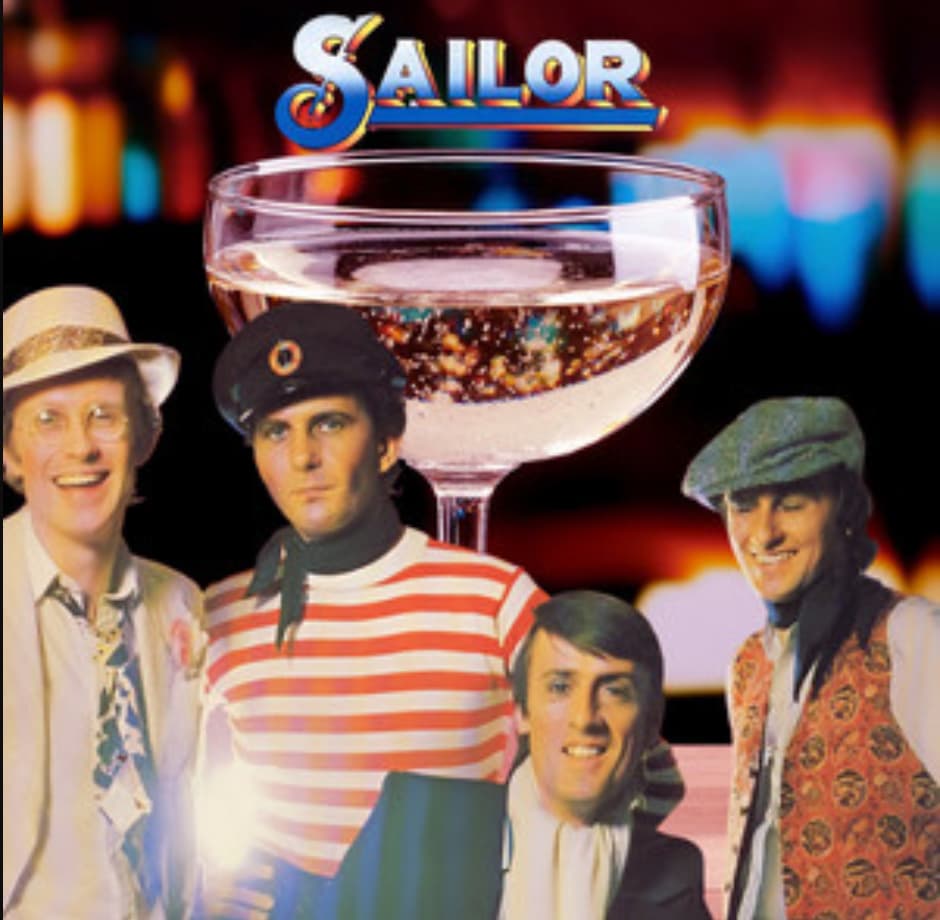
A Playful Portrait of Office Life Wrapped in Nostalgia and Subtle Social Observation
When speaking of late-1970s pop that carried both charm and a knowing wink, one cannot overlook “The Secretary” by Sailor. Released in 1978 as part of the album Checkpoint, the song arrived at a time when the band was transitioning from their earlier, more whimsical European success into a slightly more polished, radio-friendly sound. While it did not achieve the same commercial heights as their earlier hit “Girls, Girls, Girls”, “The Secretary” still found modest chart success in parts of Europe, particularly in Germany and Switzerland, where Sailor maintained a loyal following. In the UK, however, the song barely made a ripple, reflecting the changing musical climate as disco and punk began to dominate the airwaves.
Yet, chart positions alone rarely tell the full story. “The Secretary” is one of those songs that reveals its true value over time—especially to listeners who have lived long enough to recognize the subtle ironies embedded within its lyrics. Written primarily by band members Georg Kajanus and Henry Marsh, the song paints a vivid, almost cinematic picture of office life in the late 20th century. Through a light, almost playful melody, it tells the story of a secretary who navigates her daily routine with quiet resilience, perhaps even unspoken dreams.
What makes the song particularly compelling is its tone. On the surface, it feels cheerful—almost breezy—with its distinctive arrangement featuring the band’s signature use of the nickelodeon sound. But listen more closely, and there is a layer of gentle melancholy beneath the surface. The character of the secretary becomes more than just a figure in a workplace; she becomes a symbol of countless individuals whose lives unfold in routine, whose aspirations are often tucked away behind polite smiles and neatly typed memos.
For many listeners, especially those who recall the rhythms of office life before the digital age, “The Secretary” evokes a very specific world: the clatter of typewriters, the quiet hierarchy of corporate spaces, and the unspoken relationships that shaped everyday interactions. It is a reminder of a time when communication was slower, more deliberate, and perhaps more personal.
There is also an undercurrent of social commentary woven into the song. Without ever becoming heavy-handed, Sailor subtly reflects on the role of women in the workplace during that era. The secretary, often overlooked, becomes the emotional center of the narrative. She is efficient, observant, and quietly indispensable—yet rarely acknowledged beyond her function. In this sense, the song captures a transitional moment in cultural history, when traditional roles were beginning to be questioned, even if only softly.
Musically, the track retains the band’s characteristic elegance. The arrangement is meticulously crafted, with a balance between pop accessibility and a slightly theatrical flair. This was, after all, part of Sailor’s identity—a group that never quite fit neatly into one category. They were storytellers as much as musicians, and “The Secretary” is a fine example of that narrative instinct.
Looking back today, the song carries a different weight. It is no longer just a light pop tune from 1978; it is a small time capsule, preserving the textures and emotions of an era that now feels distant. For those who encounter it again after many years, it often brings with it a quiet wave of memory—of workplaces long gone, of people once known, of moments that seemed ordinary at the time but have since become precious.
In the end, “The Secretary” is not about grand drama or sweeping statements. Its beauty lies in its restraint, in its ability to suggest rather than declare. And perhaps that is why it endures, quietly, in the hearts of those who take the time to listen closely.