
A Quiet Ballad of War’s Aftermath and a Man Lost in Silence
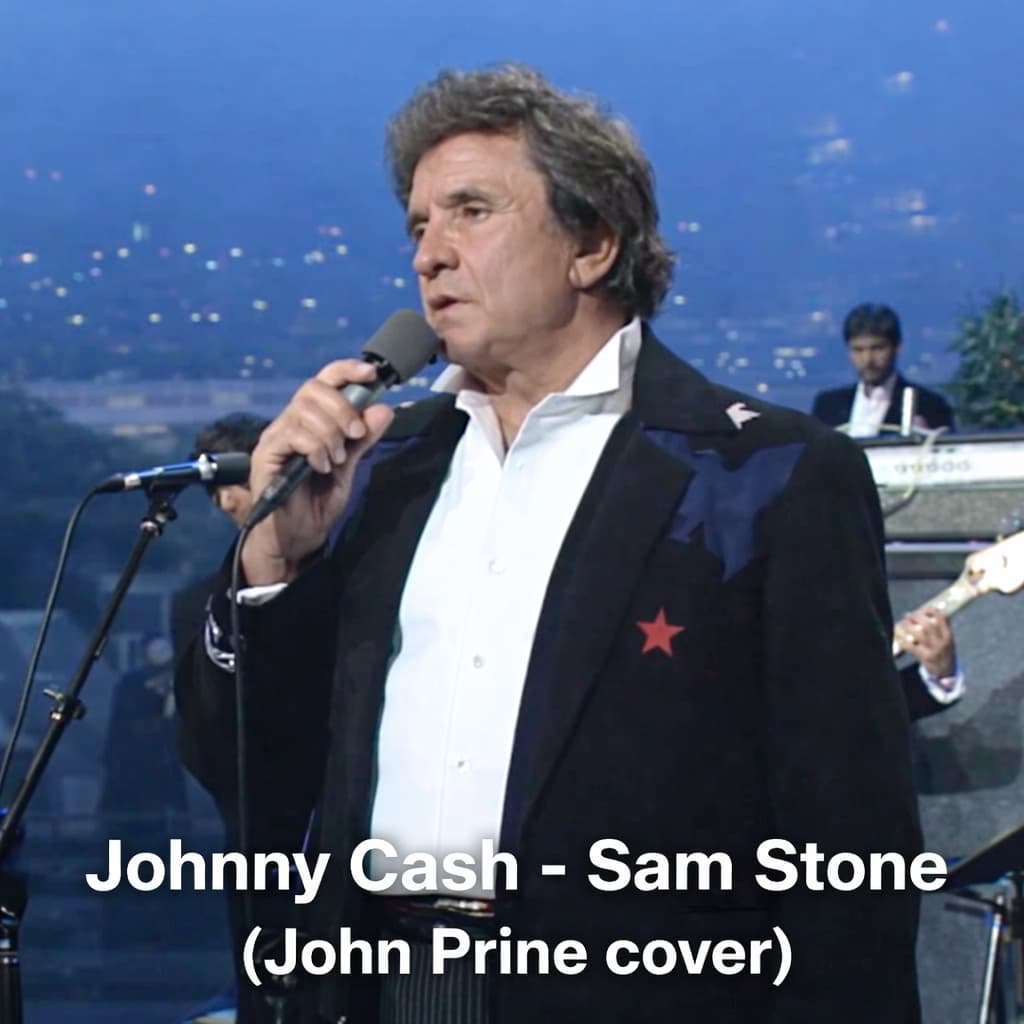
When Johnny Cash stepped onto the stage in Austin, Texas, to perform “Sam Stone”, he was not merely revisiting a song—he was carrying forward a deeply human story first written by John Prine. Originally released in 1971 on Prine’s self-titled debut album John Prine, the song never climbed high on commercial charts, yet its emotional gravity secured it a lasting place among the most respected compositions in American folk music. While it did not chart as a major single, its cultural impact far outweighed any numerical ranking, becoming one of Prine’s most haunting and enduring works.
By the time Cash performed “Sam Stone” on the renowned television program Austin City Limits, the song had already lived many lives. Yet in Cash’s voice, aged and weathered like old timber, the story took on a new dimension—one that felt even more intimate, more personal. Cash, who had long been drawn to songs about the forgotten and the wounded, found in “Sam Stone” a narrative that aligned perfectly with his artistic soul.
The story behind the song is as stark as it is unforgettable. John Prine, who served as a mailman before his rise to musical prominence, often encountered veterans whose lives had been quietly unraveled after returning home. “Sam Stone” was born from those observations—a composite portrait of a soldier who comes back from war only to find himself trapped in addiction, isolation, and quiet despair. The now-famous line, “There’s a hole in daddy’s arm where all the money goes,” remains one of the most chilling and poignant lyrics ever written, not for its shock value, but for its devastating simplicity.
In Cash’s live rendition, the arrangement is stripped down, allowing the narrative to breathe. There is no need for embellishment; the truth of the song stands firmly on its own. Cash’s deep, resonant voice lends a sense of gravity that feels almost confessional. It is as though he is not performing the song, but remembering it—recalling a face, a story, a life that slipped through the cracks.
What makes “Sam Stone” so enduring is its refusal to romanticize suffering. Instead, it presents the quiet tragedy of a man who fades away not in a blaze of glory, but in the slow erosion of dignity. The song speaks to the unseen consequences of war—the battles that continue long after the soldiers return home. In doing so, it resonates across generations, reminding listeners of the cost that is often paid in silence.
For many, hearing Johnny Cash sing this song in Austin is like opening an old photograph album—each note a faded image, each lyric a memory that lingers longer than expected. It is not a performance designed to impress, but one meant to connect. And in that connection, there is both sorrow and understanding.
In the end, Johnny Cash’s interpretation of “Sam Stone” stands as a quiet tribute—not only to John Prine’s songwriting genius, but to the countless untold stories it represents. It is a reminder that some songs are not meant to top charts or fill stadiums. Some are meant simply to be heard, to be felt, and to be remembered.