
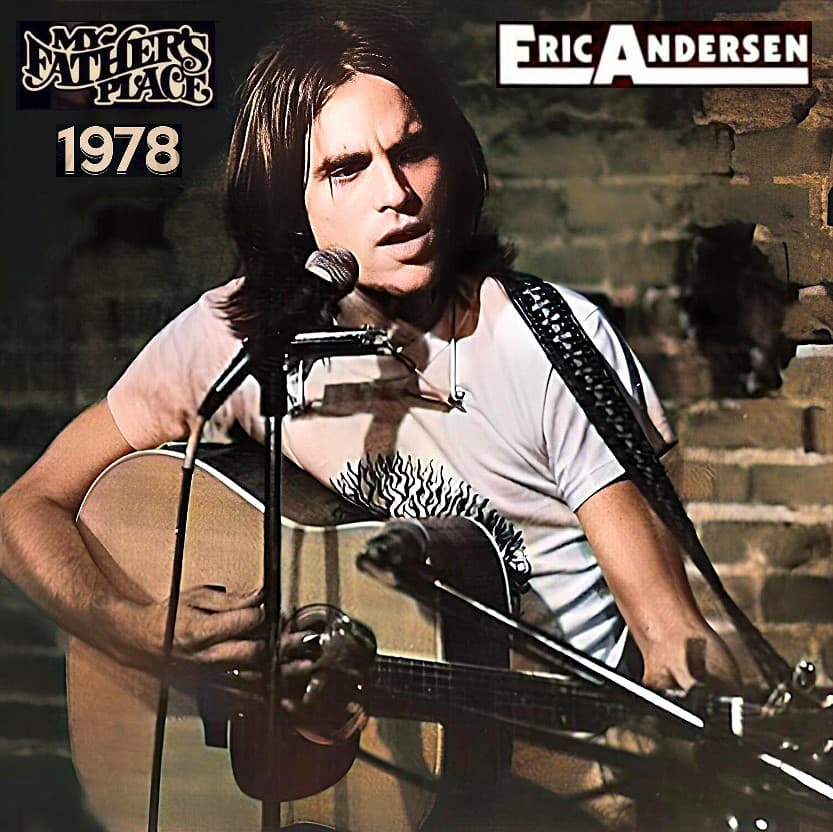
A tender question of the heart—love not as certainty, but as a quiet doubt whispered in the fading light
When “Is It Really Love At All” by Eric Andersen** first appeared in 1972 on the album _Blue River_, it did not storm the charts in the way many of its contemporaries did. In fact, it quietly lived outside the major singles rankings, never breaking into the Billboard Hot 100. Yet, for those who discovered it—often by chance, late at night, or through a well-worn vinyl copy—it became something far more enduring than a chart position: it became a companion to introspection. The album itself, however, reached a respectable No. 130 on the Billboard 200, marking a subtle but meaningful return for Andersen after a period of personal and professional silence.
By the early 1970s, Andersen was already regarded as a gifted songwriter among the Greenwich Village folk circle, often mentioned alongside figures like Bob Dylan and Joni Mitchell. Yet his career had been interrupted by illness and a long hiatus, making Blue River not just another record, but a deeply personal re-emergence. Produced with a delicate, almost fragile touch, the album carries a sense of someone returning to the world with new eyes—more cautious, perhaps, but also more sincere.
It is within this context that “Is It Really Love At All” finds its voice. The song unfolds gently, with Andersen’s soft, almost hesitant vocal delivery floating over understated instrumentation. There is no urgency here, no attempt to impress. Instead, there is a question—simple in its wording, yet profound in its implication: what if what we’ve held onto, what we’ve believed in, isn’t quite what we thought it was?
The story behind the song is not one of grand drama, but rather of quiet realization. Andersen was known for drawing heavily from personal experiences, and many listeners have long felt that this song reflects a period of emotional uncertainty in his life. Relationships, especially those that have endured time, often carry layers of habit, memory, and unspoken compromise. In this piece, Andersen seems to peel those layers back, not with bitterness, but with a kind of gentle honesty. He does not accuse, nor does he conclude—he simply wonders.
Musically, the track is rooted in the folk tradition, yet it bears the unmistakable polish of early 1970s studio craftsmanship. The arrangement is sparse, allowing every lyric to breathe. There is a warmth in the acoustic guitar, a subtle melancholy in the accompanying strings, and above all, a sense of space—space for the listener to reflect, to remember, to question.
What gives “Is It Really Love At All” its lasting power is precisely this openness. It does not dictate meaning; it invites it. For some, it recalls a love that quietly faded without confrontation. For others, it echoes the uneasy feeling of staying in something familiar, even when the heart has begun to drift. Andersen’s genius lies in his restraint—he trusts the listener to bring their own story into the song.
Over the years, Blue River has come to be regarded as one of Andersen’s finest works, often cited by critics as a hidden gem of the era. Artists and songwriters have revisited it with admiration, recognizing in its understated beauty a level of emotional truth that transcends time. Though it may not have achieved commercial dominance, its influence lingers in the quiet corners of the folk canon.
Listening to “Is It Really Love At All” today feels much like opening an old letter—one written in careful handwriting, filled with thoughts that were never meant to be loud. It reminds us that not all songs are meant to declare; some are meant to ask. And sometimes, the questions are what stay with us the longest.