
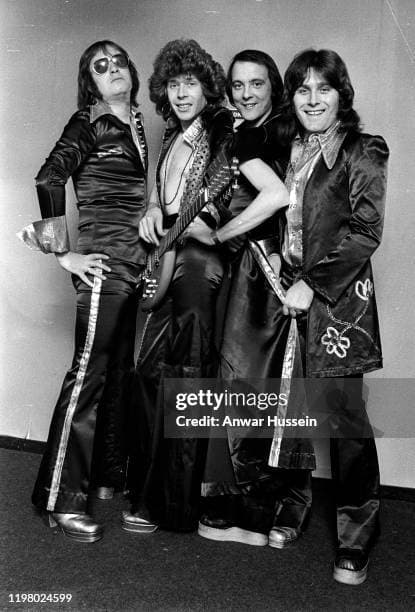
A stomping anthem of youthful confidence and glitter-era joy that captured a fleeting moment when pop was bold, simple, and irresistibly alive.
When one speaks of the golden shimmer of early 1970s British pop, it is impossible not to pause at the infectious stomp of Tiger Feet by Mud. Released in January 1974, the song did not merely enter the charts—it conquered them. It reached No. 1 on the UK Singles Chart, holding its position for four consecutive weeks, and went on to become the best-selling single in the UK for 1974. These are not small achievements; they reflect a moment when a seemingly simple pop tune became a shared heartbeat across a nation.
The song was written and produced by the legendary duo Mike Chapman and Nicky Chinn, whose craftsmanship defined much of the glam pop era. Their ability to create songs that were both commercially potent and emotionally immediate is evident in every beat of “Tiger Feet.” While the track was not originally tied to a studio album upon release, it later appeared on Mud Rock Volume 2 (1975), further cementing its place in the band’s legacy.
What makes “Tiger Feet” endure is not complexity, but clarity. Its pounding rhythm, handclaps, and chant-like chorus create an atmosphere that feels almost communal. It is a song that invites participation rather than passive listening. One can easily imagine crowded dance halls, flashing lights, and a generation momentarily freed from the weight of daily life. The lyrics themselves are playful, even cheeky—centered around admiration and flirtation—but beneath that surface lies something more enduring: a celebration of youth, confidence, and the simple thrill of being noticed.
Behind the scenes, the rise of Mud was not accidental. Managed by the astute Mickie Most, the band had struggled through earlier years before finding their identity within the glam rock movement. “Tiger Feet” represented a turning point—a moment when all the elements aligned: the right producers, the right sound, and a public ready to embrace something vibrant and unpretentious. Lead singer Les Gray delivered the vocal with a swagger that felt both theatrical and sincere, striking a delicate balance that defined the band’s appeal.
There is also a deeper cultural resonance to consider. The early 1970s in Britain were marked by economic uncertainty and social change. Glam rock, with its glitter, bold fashion, and exuberant sound, offered a form of escape. Songs like “Tiger Feet” were not meant to solve problems—they were meant to lift spirits, if only for three minutes at a time. And in that sense, the song succeeded beyond measure.
Listening to it now, decades later, one cannot help but feel a gentle pull backward in time. It evokes not just a musical style, but a mood—a world where joy could be found in rhythm and melody alone. The production may feel dated to modern ears, yet that is precisely where its charm lies. It is a snapshot, preserved in sound, of a moment when pop music wore its heart openly and unapologetically.
In the end, “Tiger Feet” remains more than just a chart-topping hit. It is a reminder of how music can define an era, how a simple chorus can unite strangers, and how certain songs, no matter how light they may seem, carry with them the weight of memory and time. For those who remember, it is not merely a song—it is a feeling that never quite fades.