
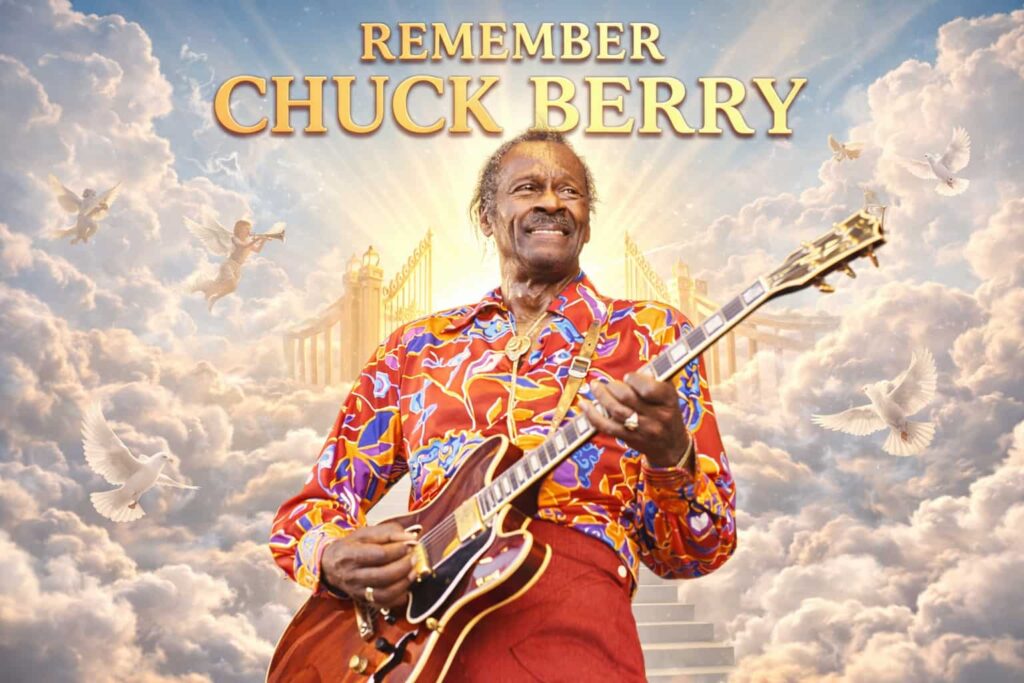
A timeless anthem of youthful ambition, “Johnny B. Goode” captures the dream of rising from humble beginnings to musical immortality.
Few songs in the history of rock and roll feel as instantly recognizable, as electrifying, and as enduring as “Johnny B. Goode” by Chuck Berry. Released in March 1958 as a single on Chess Records, the song quickly climbed the charts, reaching No. 8 on the Billboard Top 100 and No. 2 on the Billboard R&B chart. At a time when rock and roll was still finding its voice, this record didn’t just participate in the movement—it helped define it.
The opening guitar riff alone—sharp, bright, and irresistibly propulsive—became one of the most iconic introductions ever recorded. It was inspired by the piano intro of Louis Jordan’s “Ain’t That Just Like a Woman,” yet Berry transformed it into something uniquely his own: a declaration of independence for the electric guitar. In those first few seconds, one hears not just a song beginning, but a door opening into a new musical era.
At its heart, “Johnny B. Goode” tells the story of a poor country boy “who never ever learned to read or write so well,” but who could play the guitar “just like ringing a bell.” This narrative, simple as it may seem, carries the unmistakable imprint of Berry’s own life. Born in St. Louis, Berry grew up in modest circumstances, and like his fictional Johnny, he carved his way into the world through sheer talent and determination. In fact, the name “Johnny” was originally written as “colored boy” in early drafts—a detail Berry wisely altered, making the song more universally accessible during a racially sensitive era in American history.
The meaning of the song resonates deeply even decades later. It is, fundamentally, a celebration of possibility—the idea that talent and passion can transcend limitations. Yet there is also a quiet poignancy in the line, “Someday your name will be in lights.” It speaks not just of hope, but of longing—the kind that lives in anyone who has ever dreamed of being seen, heard, and remembered.
Musically, the track is a masterclass in economy and drive. Berry’s guitar work, filled with double-stops and rhythmic precision, became a blueprint for generations to come. One can draw a direct line from this song to the styles of artists like Keith Richards and Angus Young, both of whom have acknowledged Berry’s profound influence. The rhythm section, meanwhile, moves with a steady, almost locomotive force—never overwhelming, always supporting the storytelling at the song’s core.
There is also a cultural weight to “Johnny B. Goode” that extends far beyond its chart success. In 1977, the track was selected for inclusion on the Voyager Golden Record, a phonograph record sent into space aboard the Voyager spacecraft as a representation of Earth’s artistic achievements. Imagine that: among all the music humanity could offer to the cosmos, this song—born in a modest Chicago studio—was chosen to speak for us. It’s a testament not only to Berry’s genius but to the universal language of rock and roll itself.
Listening to “Johnny B. Goode” today is like opening a well-worn photo album. The sound may be crisp, the tempo lively, but beneath it lies something tender and enduring. It recalls a time when music felt like discovery, when a three-minute song could carry the weight of a lifetime’s dreams. For those who lived through its arrival, it was more than a hit record—it was a signal that the world was changing, and that perhaps, just perhaps, anyone with a guitar and a dream could change it too.
And so the song remains—not merely as a relic of the past, but as a living, breathing reminder of where it all began. In every ringing note and every hopeful lyric, “Johnny B. Goode” continues to whisper the same promise it did in 1958: that greatness can rise from anywhere, and that sometimes, all it takes is a song to light the way.