
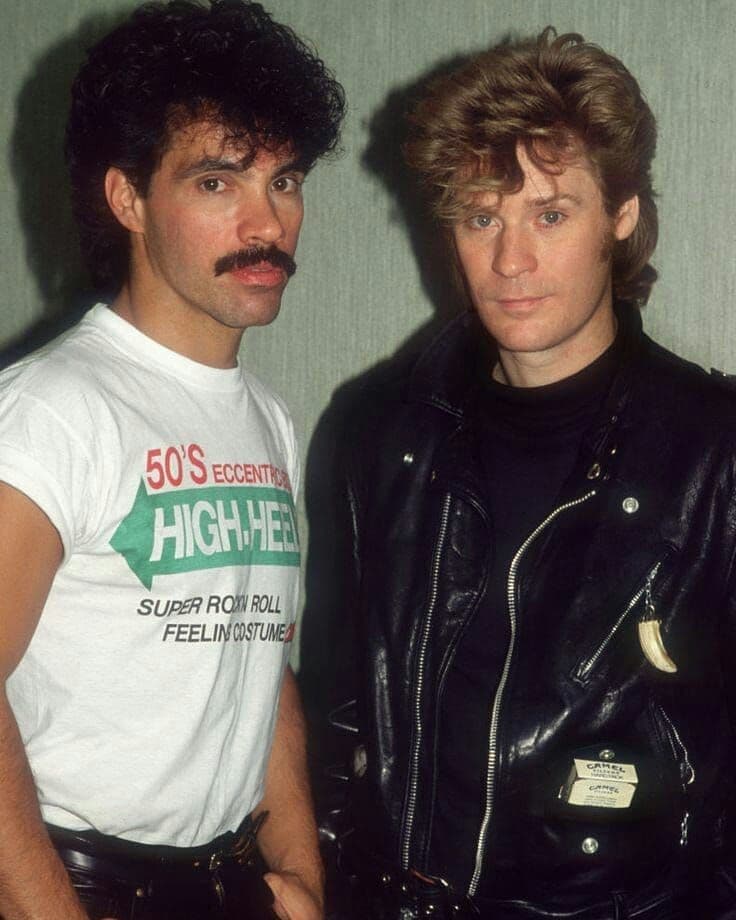
When success surrounds you, but something inside quietly slips away — the lingering emptiness behind “Out of Touch”
Released in October 1984, “Out of Touch” by Hall & Oates quickly climbed to the top of the charts, becoming one of the duo’s most commercially successful singles. It reached No. 1 on the Billboard Hot 100 in the United States and also performed strongly internationally, marking yet another peak in a career that had already defined much of early ’80s pop-soul. The track appeared on their album “Big Bam Boom” (1984), a record that embraced a more electronic, drum-machine-driven sound—an evolution that reflected the changing musical landscape of the mid-1980s.
But beyond its polished production and infectious rhythm, “Out of Touch” carries a deeper, more introspective message—one that often gets overlooked beneath its glossy surface.
At first listen, the song feels energetic, even upbeat. The pulsing beat, layered synths, and crisp percussion give it the sheen of a dance track built for radio success. Yet, as was often the case with Daryl Hall and John Oates, there’s an emotional undercurrent running quietly beneath the surface.
Lyrically, “Out of Touch” speaks about disconnection—not just between people, but within oneself. It reflects a moment when everything outwardly appears to be working—success, routine, familiarity—but something essential has gone missing. That phrase, “out of touch,” becomes more than a description; it becomes a quiet confession.
By 1984, Hall & Oates were at the height of their fame. They had already delivered a string of hits—“Maneater,” “Private Eyes,” “Rich Girl”—songs that defined radio playlists for years. Yet with success often comes a strange kind of distance. There’s a sense that this song captures that feeling: being surrounded by noise, attention, and movement, but feeling emotionally disconnected from it all.
The production itself tells part of the story. “Big Bam Boom” leaned heavily into modern studio techniques, influenced in part by producer Arthur Baker, known for his work in electronic and dance music. The result is a track that feels almost mechanical at times—tight, controlled, precise. That sonic texture mirrors the song’s theme: a world moving forward efficiently, but perhaps losing a bit of its human warmth along the way.
And that’s where the song resonates most deeply.
For many listeners, especially those who lived through that era, “Out of Touch” isn’t just a chart-topping hit—it’s a quiet reflection of a time when the world was speeding up. Technology was changing music, lifestyles were shifting, and there was an unspoken question in the background: Are we keeping up… or are we losing something important along the way?
What makes Hall & Oates so enduring is their ability to embed these questions into songs that don’t feel heavy at first glance. They invite you in with melody, then leave you with something to think about long after the music fades.
Even today, listening back to “Out of Touch”, there’s a certain poignancy that wasn’t always obvious in 1984. Time has a way of revealing the emotional truth behind songs. What once sounded like a sleek pop hit now feels like a subtle meditation on modern life—on connection, distance, and the fragile thread that ties us to what truly matters.
And perhaps that’s why the song still lingers.
Because at some point, everyone understands what it means to be just a little… out of touch.