
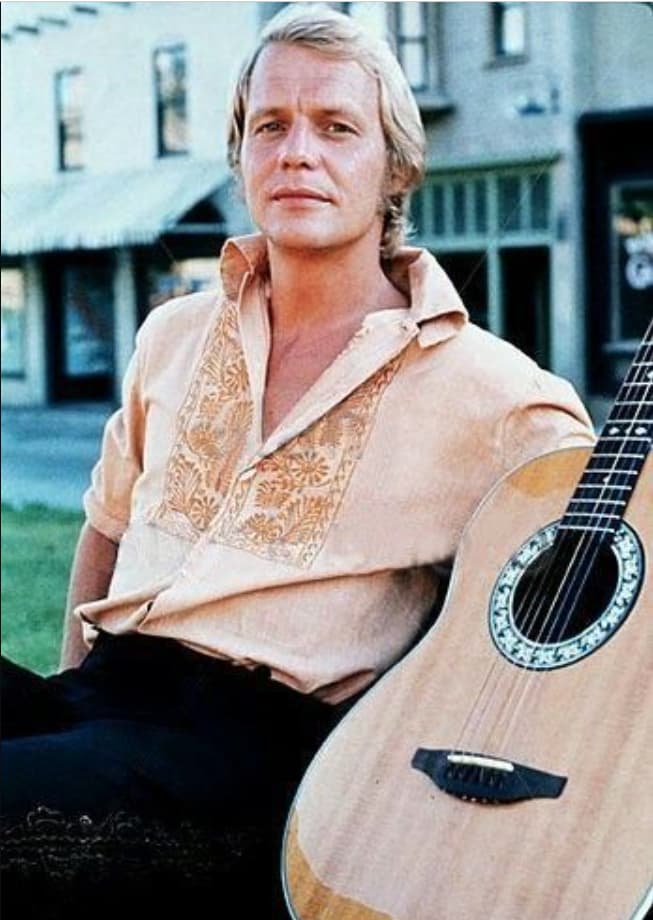
A Gentle Plea for Love’s Last Chance — When “Don’t Give Up On Us Baby” Became a Quiet Anthem of Fragile Hope
When “Don’t Give Up On Us Baby” by David Soul first reached the airwaves in late 1976, it did not arrive with thunder or spectacle—it slipped in softly, like a confession whispered in the stillness of a late evening. Yet, by early 1977, this tender ballad had climbed to the very top, reaching No. 1 on the Billboard Hot 100 in the United States and No. 1 on the UK Singles Chart, an achievement that firmly established David Soul—already known to millions from television—as a serious presence in the world of music.
Released as a single from his debut album David Soul (1976), the song was written by Tony Macaulay, a songwriter with a gift for capturing emotional immediacy in deceptively simple phrases. But it was Soul’s delivery—restrained, vulnerable, and tinged with quiet desperation—that transformed the song into something enduring. There is a certain honesty in his voice, as though he were not performing, but remembering.
The story behind the song’s success is inseparable from the moment in which it was born. During the mid-1970s, David Soul was at the height of his fame as one half of the hit television series Starsky & Hutch. Yet beneath the surface of that glamorous success was a desire to be taken seriously as a musician. In many ways, “Don’t Give Up On Us Baby” became his declaration—a turning point that proved he could step out from behind the screen and speak directly through song.
What makes the song resonate, even decades later, is its emotional clarity. At its heart, it is a plea—not grand, not dramatic, but deeply human. It speaks to that fragile moment in any relationship when words feel insufficient, when pride must give way to vulnerability. Lines like “Don’t give up on us, baby / We’re still worth one more try” carry a weight that feels lived-in, not imagined. There is no illusion of perfection here—only the quiet hope that something broken might still be repaired.
Musically, the arrangement is understated, allowing space for reflection. The gentle piano, the soft orchestration, and the measured pace all serve to frame the vocal rather than overpower it. This restraint is precisely what gives the song its lasting power. It does not demand attention; it invites it.
It is also worth noting that the song’s success was not merely a fleeting moment. In both the United States and the United Kingdom, it stood as one of the defining ballads of its era—an era when storytelling and sincerity often took precedence over production spectacle. For listeners who first encountered it during its chart-topping run in 1977, the song became more than just a hit—it became part of the emotional landscape of that time.
Over the years, “Don’t Give Up On Us Baby” has continued to echo quietly through radio waves and memory alike. It remains one of those rare songs that does not age so much as deepen. With each passing year, its message seems to grow more poignant, its simplicity more profound.
In the end, David Soul gave the world more than a successful single—he offered a moment of truth set to melody. And perhaps that is why the song still lingers. Because long after trends fade and charts are forgotten, the feeling it carries—the hope that love, even when strained, might still endure—remains as familiar as ever.
 Great Songs