
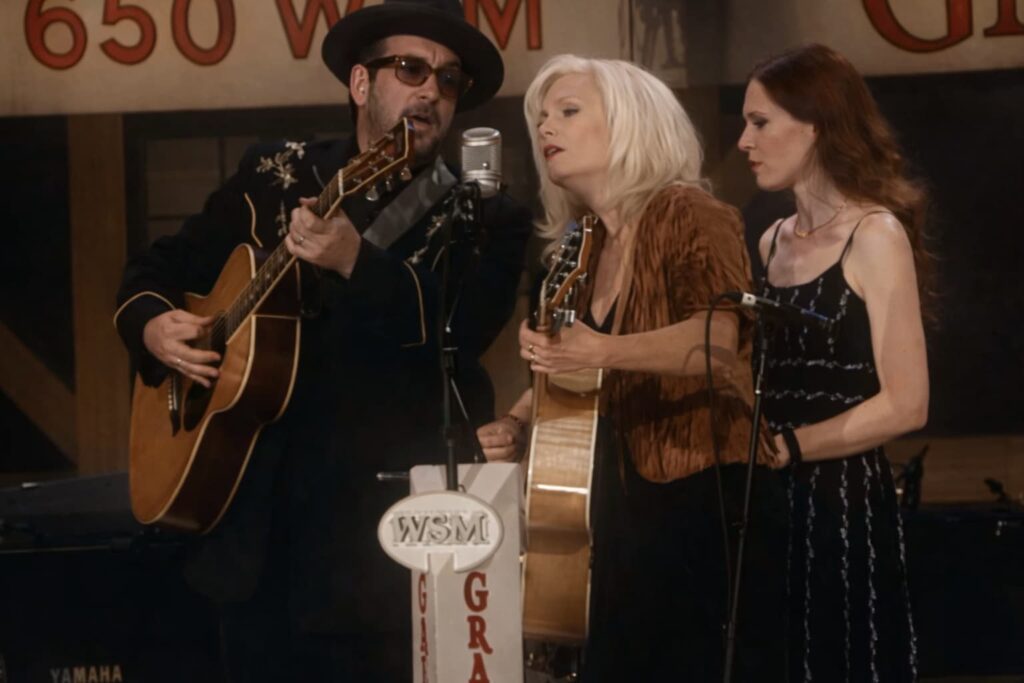
When Love Endures, It Still Leaves a Mark — A Tender Reunion of Two Voices That Understand Pain
Few songs in the popular canon have traveled as far, emotionally and historically, as “Love Hurts”. By the time Emmylou Harris and Elvis Costello stood side by side to perform it live in 2006, the song had already lived several lifetimes—each version adding another layer of meaning, another shade of sorrow. Their duet did not merely revisit an old classic; it quietly reframed it, like two seasoned storytellers returning to a familiar tale, now carrying the weight of years behind every word.
Originally written by Boudleaux Bryant in 1960, “Love Hurts” first appeared through The Everly Brothers, though it was the 1975 recording by Nazareth that propelled it into global recognition, reaching No. 8 on the Billboard Hot 100 and No. 1 in several countries, including Norway and the Netherlands. Over time, the song became something of a universal confession—its simple structure allowing each artist to pour their own truth into it. And yet, in 2006, when Emmylou Harris and Elvis Costello brought it to the stage, they did something rare: they stripped the song back to its emotional skeleton.
By that point, Emmylou Harris had long been regarded as one of the most elegant interpreters of American roots music. Her voice, often described as ethereal, carried a quiet resilience—an understanding of heartbreak not as a dramatic rupture, but as something that settles into the soul over time. Elvis Costello, on the other hand, came from a different lineage—sharp, literate, often restless in his musical identity. His voice carried a kind of intellectual ache, a tension between control and vulnerability. Together, they formed an unlikely but deeply compelling pairing.
The 2006 performance is particularly striking because it avoids theatricality. There is no attempt to outdo previous versions, no grand reinvention. Instead, what emerges is a conversation—two voices meeting in the middle of a shared understanding. When they sing “Love hurts, love scars…”, it no longer sounds like a youthful lament. It feels lived-in, almost accepted. The pain is not questioned; it is acknowledged, even respected.
The story behind this collaboration is rooted in mutual admiration. Emmylou Harris has always been drawn to songwriters and performers who treat music as a form of emotional truth-telling, while Elvis Costello has consistently sought out partnerships that challenge and expand his artistic boundaries. Their paths had crossed before in various musical circles, but this performance stands as one of their most intimate intersections—a moment where neither artist dominates, and the song itself takes precedence.
What makes this rendition particularly meaningful is how it reflects the passage of time—not just in the lives of the performers, but in the listener as well. A song like “Love Hurts”, when heard in youth, often feels immediate and raw, almost overwhelming. But decades later, it becomes something quieter, more reflective. The 2006 version captures that transformation beautifully. It is not about the shock of heartbreak, but about its endurance—how it lingers, softens, and becomes part of one’s emotional landscape.
There is also a subtle dignity in the way both artists approach the material. Emmylou Harris delivers her lines with a kind of gentle clarity, never forcing the emotion, allowing it to surface naturally. Elvis Costello, meanwhile, tempers his usual intensity, meeting her in a space that feels almost sacred. The result is a performance that does not demand attention, but rewards those who give it.
In the end, this version of “Love Hurts” is less about the pain itself and more about the understanding that comes after. It reminds us that some songs are not meant to be outgrown—they simply change shape as we do. And when voices like Emmylou Harris and Elvis Costello come together to revisit such a song, they do not just perform it; they honor it, quietly and profoundly.