
A Gentle Farewell to a Vanished World — Where Memory, Loss, and Home Still Echo in Every Line
When “Paradise” was first introduced to the world through John Prine’s 1971 self-titled debut album “John Prine”, it did not arrive with the thunder of chart-topping ambition. In fact, the song was never released as a major commercial single, and thus did not secure a prominent position on the mainstream charts at the time. Yet, over the decades, its quiet resonance has proven far more enduring than many chart successes of its era. This is a song that lives not in numbers, but in memory — passed from one generation of listeners to another like a well-worn photograph.
Written by John Prine, one of America’s most perceptive and compassionate songwriters, “Paradise” draws directly from his family’s roots in Muhlenberg County, Kentucky. The story behind the song is deeply personal: Prine’s parents grew up in a small town called Paradise, a place that once thrived along the Green River. However, by the time Prine came of age, much of that community had been devastated by strip mining, largely driven by the Peabody Coal Company. The town was effectively erased — not just physically, but emotionally — leaving behind a silence that Prine would later transform into music.
The song itself is structured as a recollection — a conversation between past and present, innocence and understanding. Its most famous line, “And daddy, won’t you take me back to Muhlenberg County…,” is not merely a nostalgic plea. It is a lament for something irretrievably lost. Through deceptively simple lyrics and a melody that feels almost like a folk lullaby, Prine captures the universal ache of watching one’s homeland change beyond recognition.
What makes “Paradise” so powerful is its restraint. Prine does not shout, nor does he preach. Instead, he allows the listener to arrive at the truth gently: that progress often comes at a cost, and that some losses can never be reclaimed. The imagery of the Green River, once a symbol of life and continuity, becomes a haunting reminder of what has been sacrificed.
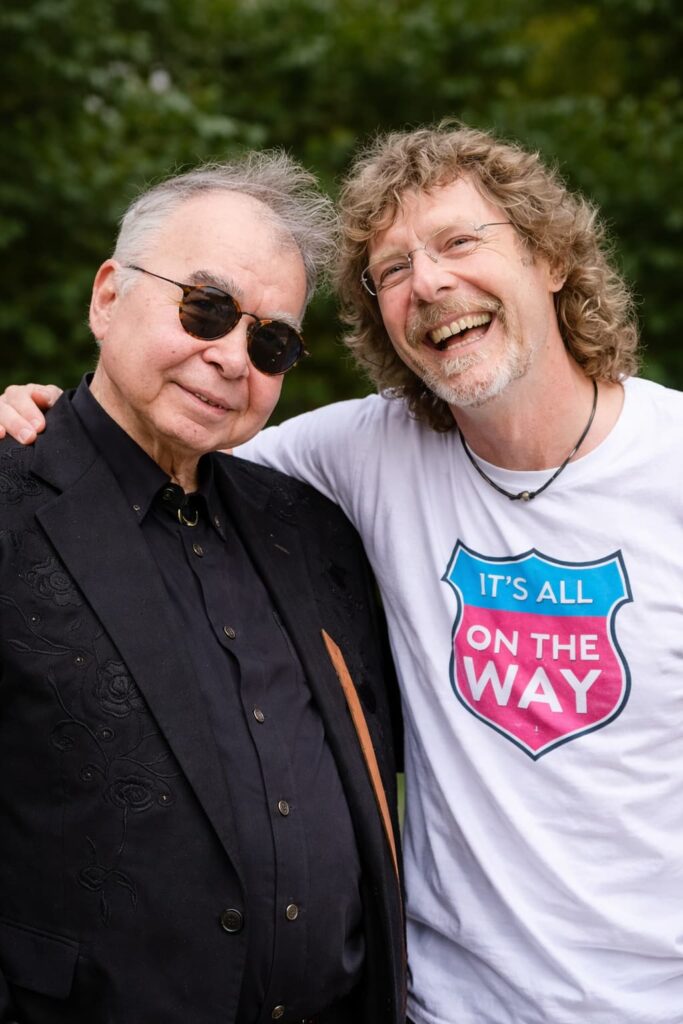
In later years, Sam Bush, a pioneer of progressive bluegrass, would join Prine in performing “Paradise”, bringing a slightly different texture to the song while preserving its emotional core. Bush’s mandolin work adds a layer of warmth and earthiness, reinforcing the song’s Appalachian roots. Together, John Prine & Sam Bush deliver performances that feel less like concerts and more like shared remembrances — as though they are inviting the audience to sit beside them and reflect on a place that exists now only in stories.
Beyond its historical context, the meaning of “Paradise” has only deepened with time. It speaks not just of one town in Kentucky, but of countless communities around the world that have been reshaped or erased in the name of industry and progress. It reminds us that behind every statistic lies a human story — a family, a childhood, a sense of belonging.
For many listeners, especially those who have witnessed change firsthand, the song carries an almost sacred weight. It is not simply about environmental loss or economic transformation; it is about memory itself — how it preserves what the world has forgotten, and how music can give voice to what can no longer be seen.
In the end, “Paradise” stands as one of John Prine’s most enduring compositions, not because it sought fame, but because it spoke with honesty. It is a song that does not age, because its truth remains constant. And perhaps that is why, long after the charts have been forgotten, its melody still lingers — like the echo of a river that once flowed freely through a place called Paradise.