
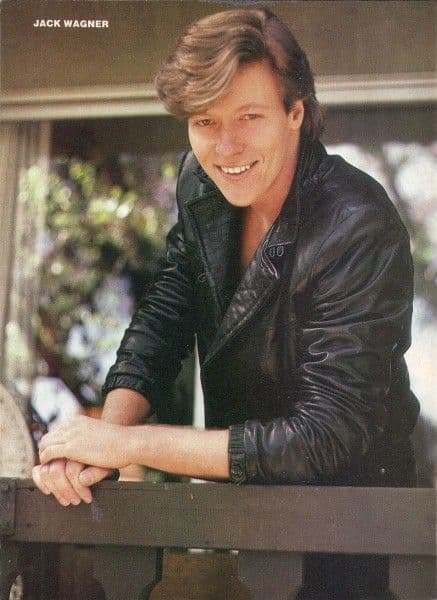
A gentle anthem of enduring devotion—“Love Can Take Us All the Way” reminds us that true love, once found, carries us through every season of life.
Released in 1986, “Love Can Take Us All the Way” by Jack Wagner arrived at a moment when polished pop ballads still held a firm place in the hearts of listeners. Featured on his album Lighting Up the Night, the song did not achieve the towering commercial success of his earlier hit “All I Need” (which reached No. 2 on the Billboard Hot 100 in 1984), yet it carved out its own quiet space—peaking at No. 15 on the Billboard Adult Contemporary chart. And perhaps that is fitting, because this is not a song that demands attention; rather, it earns it slowly, patiently, like the kind of love it so tenderly describes.
By the mid-1980s, Jack Wagner was already a familiar face and voice. Known widely for his role on the soap opera General Hospital, he had successfully crossed over into music, embodying that rare blend of screen presence and vocal sincerity. But unlike many crossover artists of the era, Wagner approached music with a certain earnestness that set him apart. There was no sense of novelty here—only a genuine desire to communicate emotion in its purest form.
“Love Can Take Us All the Way” is, at its core, a meditation on perseverance—on the quiet, steadfast belief that love is not merely a fleeting feeling, but a guiding force. The arrangement is unmistakably of its time: soft synthesizers, gentle percussion, and a melody that unfolds without haste. Yet beneath that familiar 1980s sheen lies something far more enduring. Wagner’s voice, warm and slightly hushed, carries a sense of vulnerability that feels almost confessional. He does not proclaim love as a grand triumph; instead, he presents it as a journey—one that requires patience, trust, and a willingness to endure.
The story behind the song is less about dramatic inspiration and more about the musical climate of the era. The mid-80s were saturated with power ballads, but this track stands apart for its restraint. Where others soared, Wagner lingered. Where others reached for spectacle, he chose intimacy. It is precisely this understated quality that allows the song to resonate so deeply. It feels less like a performance and more like a quiet conversation—perhaps one shared late at night, when the world has slowed down and the heart speaks more honestly.
Lyrically, the message is simple, yet profoundly comforting: love, when nurtured and believed in, has the power to overcome distance, doubt, and time itself. There is no cynicism here, no hint of disillusionment. Instead, the song offers a kind of emotional reassurance that feels increasingly rare. It reminds us of a time when love songs were not ironic or self-aware, but deeply sincere—when they dared to believe in something lasting.
Listening to “Love Can Take Us All the Way” today is like opening an old photograph album. The edges may be slightly worn, the colors softened by time, but the feelings remain vivid. It evokes memories not just of a particular decade, but of moments—of quiet drives, of handwritten letters, of promises made and kept. It speaks to the enduring human hope that, despite everything, love can still guide us forward.
In the broader landscape of 1980s pop, the song may not dominate playlists or retrospectives. Yet its quiet legacy persists among those who remember the warmth it once brought—and still does. Jack Wagner, with this gentle ballad, offered something more lasting than a chart-topping hit: he offered a reminder that the simplest truths are often the most powerful.
And in that sense, “Love Can Take Us All the Way” has already fulfilled its promise.