
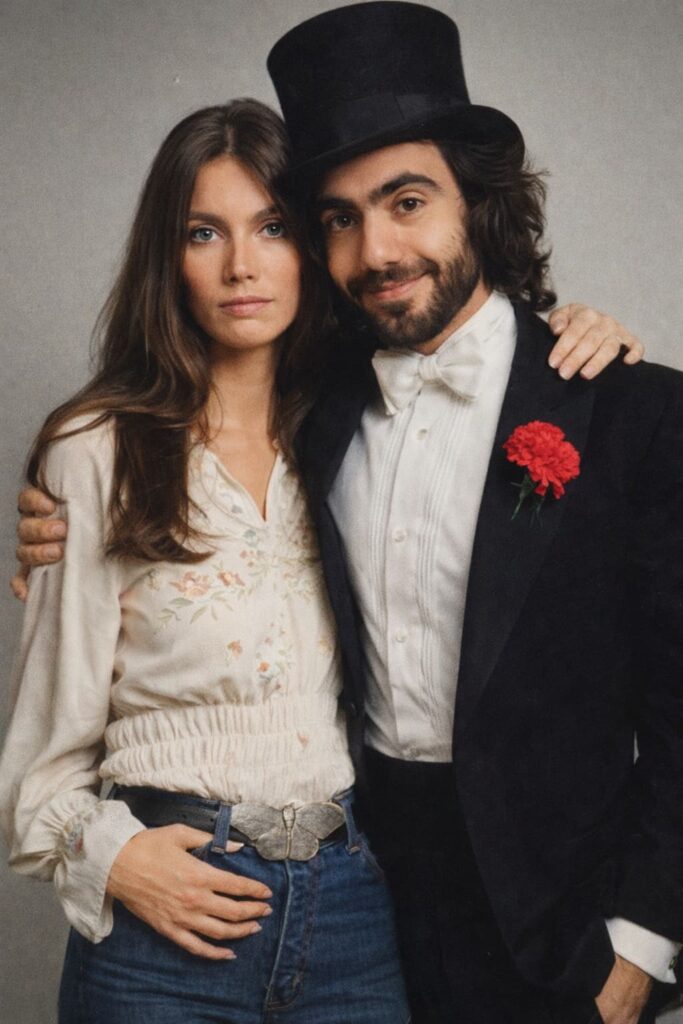
A Tender Farewell Wrapped in Time — “Fourteen Days” as a Quiet Meditation on Love, Distance, and the Passing of Moments
Few songs carry the gentle weight of time and tenderness quite like “Fourteen Days”, a reflective composition by Steve Goodman, later brought to life with luminous grace through a duet with Emmylou Harris. Though not a major chart-topping single upon its release, the song holds a cherished place in the deeper corners of American folk and country music, admired for its emotional sincerity rather than commercial ambition.
“Fourteen Days” was written by Steve Goodman, one of the most respected singer-songwriters of the 1970s, best known for his ability to capture life’s fleeting, fragile beauty in simple yet profound language. The song appeared on Goodman’s 1977 album “Say It in Private”, a record that reflected his introspective songwriting during a period when his health was already in quiet decline due to leukemia—a battle he had been fighting since his early twenties. While the album itself did not achieve high positions on mainstream charts like the Billboard 200, it was warmly received within folk circles, where Goodman’s work was held in especially high regard.
The version featuring Emmylou Harris adds an entirely new dimension to the song. Harris, whose voice had already become synonymous with emotional clarity and elegance through her work in the 1970s, lends a soft, almost ethereal harmony that complements Goodman’s more grounded and conversational tone. Their voices do not compete; rather, they seem to walk side by side—like two travelers sharing the same quiet road, aware that the journey is as important as the destination.
At its heart, “Fourteen Days” is a meditation on time—specifically, the awareness of time slipping away, measured not in years, but in small, intimate increments. The titular “fourteen days” becomes a symbolic window, a brief yet meaningful span in which emotions intensify, memories form, and goodbyes begin to take shape. There is no dramatic climax in the song, no grand declaration. Instead, it unfolds gently, like a letter written late at night, when thoughts are clearest and the world is still.
What makes the song particularly poignant is the context of Steve Goodman’s life. Knowing his ongoing struggle with illness, listeners often hear “Fourteen Days” not merely as a story of temporary separation, but as something deeper—a quiet acknowledgment of life’s impermanence. Yet, it is never burdened with despair. Goodman had a rare gift: he could speak of loss without bitterness, of endings without fear. In this way, the song becomes less about goodbye and more about appreciation—about holding onto moments while they are still within reach.
Emmylou Harris, on the other hand, brings a sense of timelessness to the recording. By the time she collaborated with Goodman, she had already established herself through albums like “Elite Hotel” (1975), which reached No. 1 on the Billboard Top Country Albums chart. Her presence in “Fourteen Days” feels almost like a bridge—connecting Goodman’s introspective world with a broader audience that understood the quiet power of country storytelling.
Over the years, “Fourteen Days” has not been a song that dominates radio playlists or retrospective chart rankings. Instead, it has endured in a more meaningful way—passed from listener to listener, often discovered during quiet moments rather than crowded ones. It belongs to that special category of songs that seem to wait patiently until the listener is ready to truly hear them.
Listening to “Fourteen Days” today is like opening an old photograph—one slightly faded, yet rich with emotion. It reminds us that music does not always need grandeur to leave a lasting impression. Sometimes, all it takes is honesty, a gentle melody, and the courage to speak softly about things that matter most.
In the end, Steve Goodman and Emmylou Harris created something that feels less like a performance and more like a shared memory—one that lingers quietly, long after the final note has faded.