
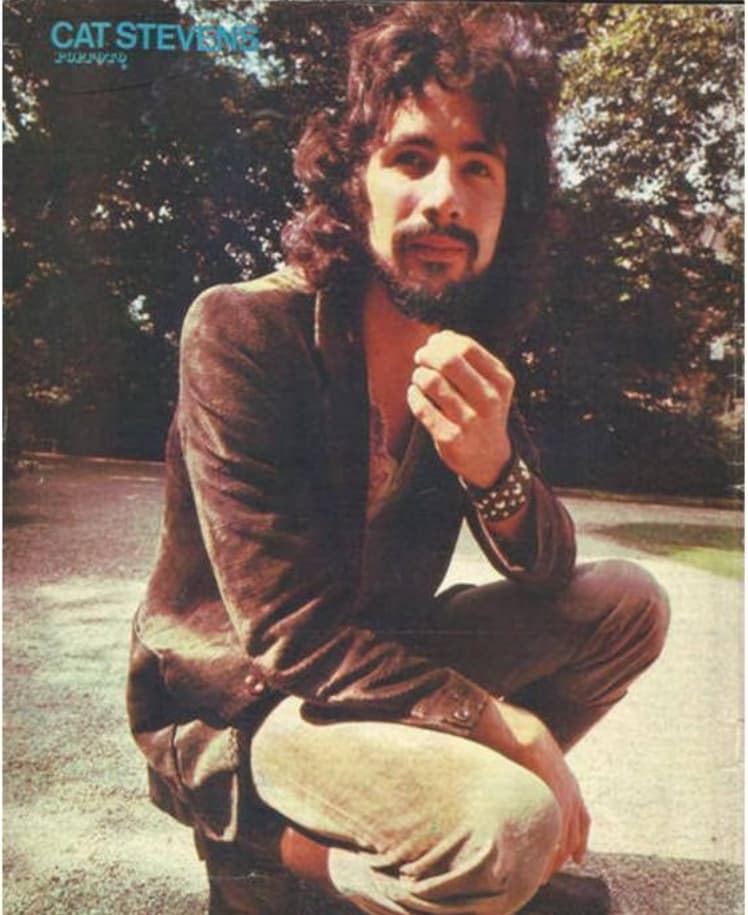
A Gentle Farewell Wrapped in Wisdom — A Song About Letting Go, Yet Never Truly Leaving
When Wild World was released in 1970, it quickly found its way into the hearts of listeners who understood that love is not always about holding on, but sometimes about knowing when to let go. Written and performed by Cat Stevens (later known as Yusuf Islam), the song appeared on the deeply personal album Tea for the Tillerman, a record that would come to define his artistic peak.
From a chart perspective, the song performed modestly yet meaningfully. It reached No. 11 on the Billboard Hot 100 in the United States and climbed to No. 7 in the UK Singles Chart. These positions, while not topping the charts, hardly reflect the enduring emotional weight the song has carried across generations. Its true success lies not in numbers, but in memory—in quiet evenings, in long drives, in moments of reflection.
The story behind “Wild World” has long been tied to Stevens’ relationship with actress Pattie Boyd, who was also famously connected to George Harrison and later Eric Clapton. Though Stevens never confirmed every detail outright, the emotional authenticity of the song suggests a deeply personal farewell. It is not a bitter goodbye, nor a dramatic one—it is tender, almost protective. A man watches someone he loves walk away, offering not resistance, but concern.
What makes “Wild World” so enduring is its duality. On the surface, it is a simple acoustic tune, carried by a gentle melody and a memorable chorus. But beneath that simplicity lies a quiet wisdom. The lyrics speak of a world that is unpredictable, even harsh at times. Yet they are delivered without cynicism. Instead, there is a soft plea: “Take good care.” It is the voice of someone who has loved deeply enough to worry, but matured enough to release.
For many listeners, especially those who have lived through love, loss, and the passage of time, this song resonates on a profoundly personal level. It reminds us of moments when we stood at emotional crossroads—when we said goodbye not because we wanted to, but because it was necessary. The song does not dramatize heartbreak; it dignifies it.
Musically, Stevens’ arrangement is deceptively simple. The rhythmic guitar pattern, influenced by Caribbean sounds, creates a subtle sense of movement—as if life itself is continuing forward, regardless of our wishes. His voice, warm yet slightly fragile, carries the weight of someone who understands that love does not always promise permanence.
Over the decades, “Wild World” has been covered by various artists, most notably by Mr. Big in 1993, introducing the song to a new generation. Yet no version quite captures the intimacy of the original. Stevens’ recording feels less like a performance and more like a conversation—one that many of us have had, or perhaps wished we could have had.
In the end, “Wild World” is not just a song about goodbye. It is about care that lingers beyond presence, about love that transforms rather than disappears. It gently reminds us that even when paths diverge, the feelings we once held remain quietly within us—unchanged, undemanding, and, in their own way, eternal.