
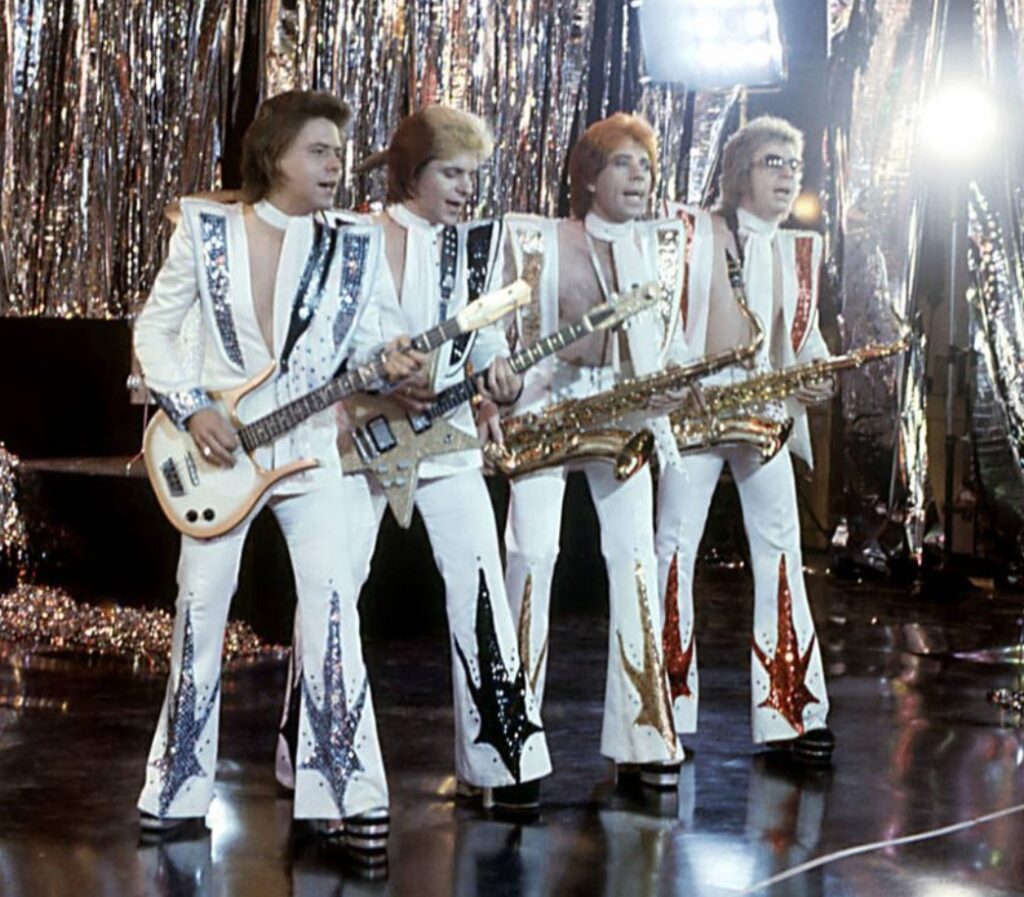
Rock and Roll Part 2 — a wordless chant that captured the raw heartbeat of early-1970s rock
When “Rock and Roll Part 2” bursts from the speakers, it does not arrive as a song in the traditional sense. There is no story told through verses, no poetry carried by lyrics. Instead, there is rhythm, repetition, and a primal chant — a piece of music that feels less like something to be understood and more like something to be felt. Credited to The Glitter Band and released in 1972, this track became one of the most recognizable rock instrumentals of its era, carving out a place in popular culture that far outlived its time on the charts.
Right from its release, the impact was undeniable. “Rock and Roll Part 2” climbed to No. 2 on the UK Singles Chart in 1972, held back from the top spot only by the fierce competition of that moment in British pop. Across the Atlantic, it reached No. 7 on the Billboard Hot 100 in the United States — an impressive achievement for a largely instrumental recording built on drums, handclaps, and a hypnotic groove. These chart positions placed the song firmly at the center of the glam-rock explosion that was sweeping through early-1970s Britain.
The story behind the song is inseparable from the sound of its time. Glam rock was loud, theatrical, and unapologetically physical. It was music meant to be stomped to, shouted along with, and experienced collectively. The Glitter Band, originally assembled as a backing group, found their own identity through this track. The pounding twin-drum rhythm, the driving beat, and the famous shouted refrain — half-chant, half-celebration — captured the communal energy of live rock music better than almost anything else released that year.
What gives “Rock and Roll Part 2” its enduring power is its simplicity. The song doesn’t ask the listener to analyze; it invites them to participate. The repeated beat feels like footsteps on a wooden stage, while the chant sounds like a crowd unified by nothing more than shared excitement. In a time before digital perfection, this track celebrates the physicality of music — sweat, movement, and the joy of noise made together.
Over the years, the song took on a second life far beyond the record charts. It became a fixture at sporting events, arenas, and public gatherings, used to ignite excitement and bring crowds together in a single rhythmic pulse. Many listeners encountered it not on the radio, but echoing through stadium speakers, where its beat felt almost ceremonial. In that setting, its lack of lyrics became its strength — anyone could join in, regardless of language or background.
Yet, like many artifacts of the early 1970s, the song carries a complicated legacy. Time has cast long shadows over parts of its history, and for some, those shadows are impossible to ignore. Still, when heard purely as music — stripped back to rhythm and collective energy — “Rock and Roll Part 2” remains a striking example of how rock music once functioned as a shared physical experience, not just a personal one.
For listeners who remember the early 1970s, this track may recall dance halls, radio countdowns, and the thrill of hearing something new and irresistible. It speaks to an era when rock music was less introspective and more communal — when a simple beat could fill a room and make strangers move together.
In the end, “Rock and Roll Part 2” is not about words or storytelling. It is about momentum. It is about the sound of a crowd becoming one voice, one rhythm, one heartbeat. And decades later, that pulse still echoes — a reminder of a time when rock and roll was felt as much in the body as it was in the soul.